What Happens to Staff in a Business Takeover?
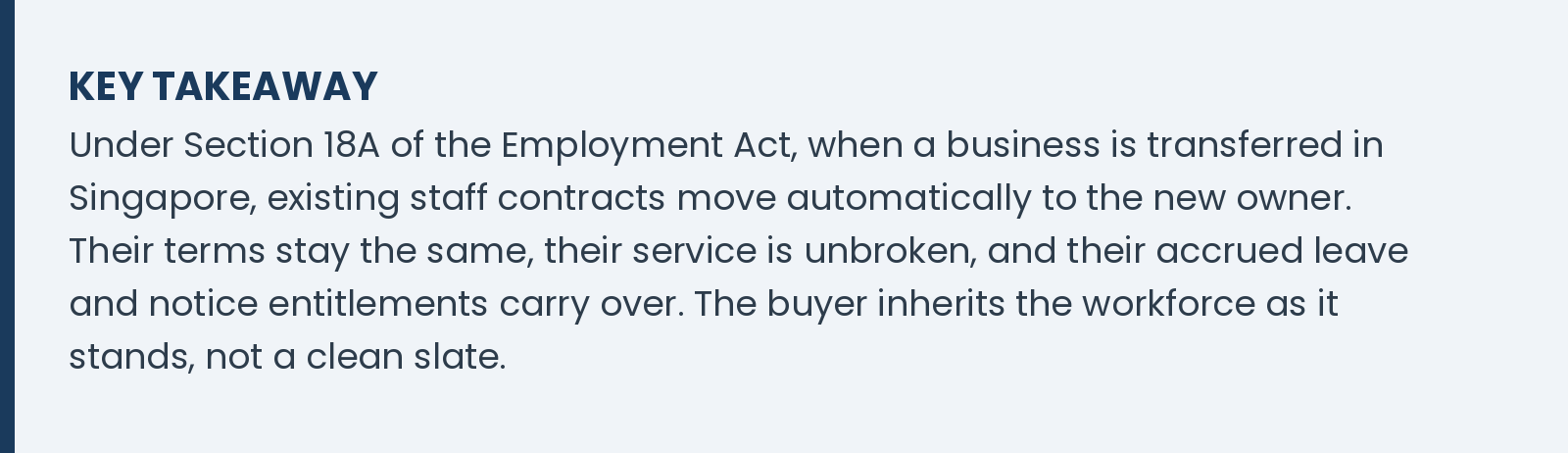
When a business itself is transferred to a new owner in Singapore, for example when you buy a shop or business as a going concern, the existing staff contracts transfer automatically under Section 18A of the Employment Act. Their terms stay the same, their service is unbroken, and their accrued leave and notice entitlements carry over. The buyer does not get a clean slate. Not every deal works this way, though: MOM says a transfer of shares or a transfer of assets only is not a transfer of employment. This guide explains when Section 18A applies, what it requires, what it costs, and what catches first-time buyers off guard.
You are not hiring the staff. You are inheriting them, along with everything they are owed.
The automatic transfer rule
Section 18A of the Employment Act applies when an undertaking (a trade or business) or part of one is transferred from one person to another. The Act says this includes disposing of a business as a going concern, and transfers by sale, amalgamation, merger, reconstruction or operation of law. The transfer does not terminate the employees' contracts. Instead, their contracts continue as if originally made with the new owner. The period of employment with the outgoing owner counts as employment with the incoming owner, so there is no break in service.
This is not optional. If the business transfer falls under Section 18A, the contracts move whether the buyer wants them or not. A buyer who plans to let go of certain staff after the takeover still inherits their contracts on day one and must follow proper procedures from that point.
What transfers with the staff
The employees' terms and conditions of employment must remain the same immediately after the transfer. That means salary, working hours, job scope, notice periods, and any contractual benefits carry across unchanged.
-
Accrued annual leave. If an employee has ten days of unused leave, you owe those ten days.
-
Sick leave balance. Statutory sick leave entitlements are based on length of service, and the service clock does not reset.
-
Notice period. The employee's notice period under their existing contract continues. You cannot shorten it unilaterally.
-
Bonus or commission obligations. If the contract includes a performance bonus or sales commission, those terms survive the transfer.
Budget for these liabilities before you agree the takeover price. Accrued leave across even a small team adds up, and under Section 18A the seller’s liabilities under those contracts become yours the moment the business transfers.
The notification obligation
The outgoing employer must notify affected employees, and their trade union if there is one, as soon as reasonable and before the transfer takes place, so that consultations can happen. Under Section 18A(5), the notice must cover the fact that the transfer is happening, the approximate date and the reasons for it, the implications of the transfer, any measures the seller plans to take in relation to the employees, and any measures the buyer plans to take once they become the employer (or the fact that none are planned). The buyer must give the seller the information needed for that last part.
If MOM’s Commissioner for Labour considers there has been an inordinate delay, the Commissioner can direct the seller (or the buyer, for their part) to comply within a set time. Agree with the seller on when and how staff will be told. A well-handled announcement keeps the team stable through the transition. A poorly handled one sends your best people looking for other jobs before you have even started.
When Section 18A does not apply
Section 18A covers the transfer of an undertaking or part of one. It does not cover every scenario a buyer might assume it does. MOM lists these as not transfers of employment:
- A transfer of assets only.
- A transfer of shares.
- A transfer of operations outside Singapore.
- Outsourcing of supporting functions.
- An incoming service provider taking over from an outgoing one during competitive tendering.
In a share sale, the company that employs the staff does not change, only its owners do. The employment contracts stay with the same company, so there is nothing for Section 18A to transfer, but the buyer still takes over a company that carries all its existing staff obligations. In an asset-only purchase, such as buying equipment, stock or a brand without the business itself, staff do not move across automatically. Any employees the buyer wants must be offered new contracts.
Some deals are structured so the seller ends the staff’s employment before completion, paying out notice and entitlements, and the buyer offers new contracts to the people it wants. Whether that takes the deal outside Section 18A depends on what is really being transferred, so if the business is still sold as a going concern, get legal advice before relying on it. This route is used deliberately, particularly where the buyer wants different staffing or where the workforce is small enough that rehiring is simpler than inheriting.
Independent contractors, freelancers, and workers on genuine contracts for service (as opposed to contracts of service) are not employees under the Act and do not transfer automatically. But misclassifying an employee as a contractor does not remove the obligation. If the worker is functionally an employee, Section 18A still applies regardless of the label on the agreement.
What to check before you agree the price
Ask the seller for a full staff list before you commit. For each employee, confirm their start date, current salary, accrued leave balance, notice period, and any contractual entitlements such as bonuses or commissions. Add up the total liability and factor it into the deal, because these are costs that arrive the day you take over.
Check whether any employee has an ongoing dispute, a medical claim, or a performance issue the seller has not resolved. Unresolved HR matters do not disappear at handover. They transfer to you along with the contract.
For a breakdown of what a takeover fee covers and how to test whether it is fair, see our guide to business takeover fees in Singapore.
How to handle the first week after takeover
Meet every employee individually in the first few days. Confirm that their terms are unchanged, answer questions about the new ownership, and set expectations for how the business will run going forward. A brief written confirmation that their employment continues on existing terms gives each person something to hold and reduces anxiety.
Do not promise changes you have not decided on. Telling staff on day one that you plan to restructure, then taking weeks to act, creates uncertainty that drives good people out. If you are keeping the team, say so clearly. If changes are coming, make them promptly and handle them properly.
When you are ready to look at opportunities, browse businesses for sale on SG Business Mart and check each listing for staffing details. Every listing connects you directly with the owner.

Frequently asked questions
Do employees transfer automatically when I buy a business in Singapore?
Only if you are taking over the business itself. Under Section 18A of the Employment Act, when a trade or business (or part of one) is transferred, for example sold as a going concern, the employees’ contracts continue with the new owner as if originally made with them, and their service is unbroken. MOM says a transfer of shares or a transfer of assets only is not a transfer of employment, so those deals work differently.
Does Section 18A apply if I buy the company’s shares?
No. MOM lists a transfer of shares as not being a transfer of employment. In a share purchase the company stays the employer and only its owners change, so the employment contracts simply continue with the same company. As the new owner, you take over a company that still carries every existing staff contract, entitlement and liability.
Does Section 18A apply if I only buy the assets?
No. MOM lists a transfer of assets only as not being a transfer of employment. If you buy equipment, stock or a brand without taking over the business as a going concern, the seller’s staff do not move to you automatically. You would need to offer new contracts to anyone you want to hire.
Does the seller have to tell staff about the takeover, and what must they share?
Yes. Under Section 18A(5), the seller must notify affected employees, and their trade union if any, as soon as reasonable and before the transfer, so consultations can take place. The notice must cover that the transfer is happening, its approximate date and reasons, its implications, and the measures the seller and the buyer plan to take in relation to the employees, or that none are planned. The buyer must give the seller the information needed for this.
Can employees refuse to be transferred to the new owner?
MOM says that if a dispute arises, the employee and employer should negotiate the terms of the transfer, and if they cannot agree, both have the right to end the employment with notice. Either side can also refer the disagreement to the Commissioner for Labour, who can delay or prohibit the transfer of that employee, or order the transfer on terms the Commissioner considers just.
Can I change staff terms after the takeover?
The transferred employees’ terms and conditions must be the same as before the transfer. MOM says the new employer must keep them unchanged unless the employees agree to a change, and Section 18A allows the new owner and employees (or their union) to negotiate and agree different terms.
Do I inherit the staff’s accrued leave and length of service?
Yes, in a Section 18A transfer. Each employee’s period of employment with the seller counts as employment with you, with no break, and all the seller’s rights, duties and liabilities under those contracts transfer to you on completion. That includes accrued leave and service-based entitlements. Agree with the seller how these will be accounted for in the price before you sign.
Which employees does Section 18A cover?
Section 18A is part of the Employment Act, which MOM says covers all employees under a contract of service, local and foreign, full-time, part-time, temporary or on contract. It does not cover seafarers, domestic workers, or statutory board employees and civil servants. Genuinely independent contractors are not employees, so they do not transfer under Section 18A.