GST Registration When Buying a Business in Singapore
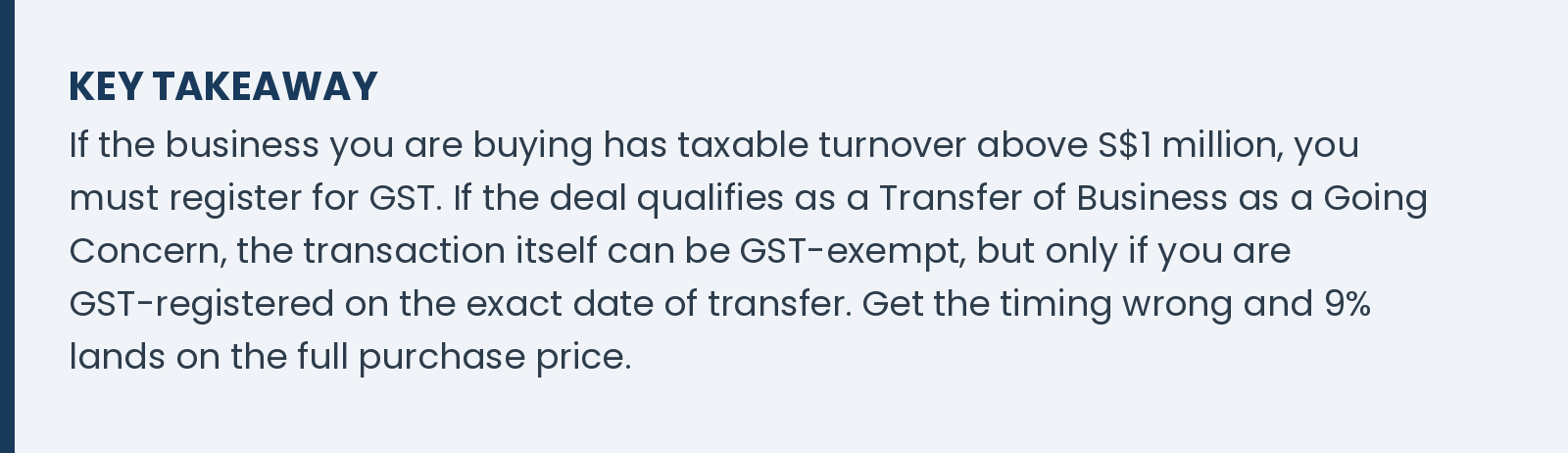
Buying a business in Singapore can trigger a GST registration obligation if the acquired business has taxable turnover above S$1 million. GST is currently 9%, so getting the registration timing wrong on a S$200,000 deal means S$18,000 in tax that lands on you rather than the transaction. If the deal qualifies as a Transfer of Business as a Going Concern, the transaction itself can be GST-exempt, but only if the buyer is GST-registered on the exact date of transfer. This guide covers the threshold, the TOGC rule, and what to do after registration.
The S$1 million threshold is tested on turnover, not profit. A busy hawker stall can cross it.
The S$1 million registration threshold
You must register for GST if the business you are buying has taxable turnover that exceeded S$1 million in the past calendar year (the retrospective test), or if you reasonably expect your taxable turnover to exceed S$1 million in the next 12 months after the acquisition (the prospective test). You only need to meet one of these to be liable.
Taxable turnover means revenue from standard-rated and zero-rated supplies. It does not include exempt supplies such as residential property rental or certain financial services. For most F&B, retail, and service businesses, nearly all revenue is taxable, so total revenue and taxable turnover are close to the same number.
If the business you are buying already earns above S$1 million, you should plan for GST registration as part of the acquisition, not as an afterthought once you are trading.
Transfer of Business as a Going Concern
A TOGC is the single most important GST concept in a business acquisition, and most small-business buyers have never heard of it.
When an entire operating business is transferred from one entity to another and the deal qualifies under IRAS guidelines, the transaction is treated as neither a supply nor an acquisition for GST purposes. No GST is charged on the purchase price. The condition that catches most buyers is that the buyer must be GST-registered on the exact date of the transfer. If the buyer's registration takes effect a day after the transfer date, the exemption fails and 9% applies to the full transaction value.
The TOGC must cover the transfer of all assets necessary to carry on the business. Cherry-picking a few assets while leaving others behind may disqualify the transaction. Both parties must also maintain clear records describing every asset transferred and its value, because IRAS may review the classification after the fact.
If your deal is large enough that the TOGC exemption matters, get a tax advisor to confirm the structure before you sign. The cost of advice is a fraction of the GST at stake.
Voluntary registration below the threshold
If the business you are buying has turnover below S$1 million, registration is not compulsory. But voluntary registration can make sense in two situations.
The first is input tax recovery. Once registered, you can claim back the 9% GST you pay on business expenses: rent, equipment, professional fees, and supplies. If your customers are mostly other GST-registered businesses who can recover the GST you charge, voluntary registration reduces your net cost base without making your prices less competitive.
The second is credibility. Some larger corporate customers and government agencies prefer to deal with GST-registered vendors. Having a GST registration number signals a certain size and compliance standard.
The trade-off is the compliance burden. GST-registered businesses must file quarterly returns, issue tax invoices that meet IRAS formatting requirements, and maintain records for at least five years. From 1 April 2026, all new voluntary registrants must also adopt InvoiceNow and transmit invoice data to IRAS via the Peppol network.
What happens if you register late
IRAS backdates the registration to the date you should have registered. Every taxable supply you made between that date and your actual registration becomes subject to GST, and the tax comes out of your margin because you did not charge it to your customers at the time.
On top of the backdated tax, IRAS applies a 10% late registration penalty on the GST due and a fine of up to S$10,000. For a business turning over S$1.2 million, the backdated GST alone can run past S$100,000. Registering on time is not a formality.
For a breakdown of what a takeover fee covers and how to check whether it is fair, see our guide to business takeover fees in Singapore.
After registration: what you need to file
GST-registered businesses file a quarterly return, the GST F5, within one month of the end of each prescribed accounting period. The return reports your output tax (GST collected from customers) and your input tax (GST paid on business expenses). You remit the difference to IRAS, or claim a refund if input tax exceeds output tax.
Keep every tax invoice, receipt, and import permit for at least five years. IRAS audits are triggered by inconsistencies in returns, and the most common finding is inadequate record-keeping, not deliberate underreporting. Good records from day one are the cheapest form of compliance insurance.
When you are ready to look at opportunities, browse businesses for sale on SG Business Mart and compare asking prices against the GST implications. Every listing connects you directly with the owner.

Frequently asked questions
Do I need to register for GST when I buy a business?
You need to register if the business you are buying has taxable turnover above S$1 million in the past calendar year, or if you reasonably expect your turnover to exceed S$1 million in the next 12 months after the acquisition. Below that threshold, registration is voluntary.
What is the GST rate in Singapore?
GST is 9% on most goods and services supplied in Singapore. The rate increased from 8% to 9% on 1 January 2024. No further changes have been announced for 2026.
What is a TOGC and how does it help?
A Transfer of Business as a Going Concern is a transaction where an entire operating business is transferred. If it qualifies under IRAS guidelines and the buyer is GST-registered on the date of transfer, the transaction is treated as neither a supply nor an acquisition for GST purposes, meaning no GST is charged on the purchase price.
What happens if I register for GST late?
IRAS backdates the registration to the date you should have registered and charges GST on every taxable supply you made in the interim. You also face a late registration penalty of 10% of the GST due and a fine of up to S$10,000.
Can I claim back GST on business expenses after registering?
Yes. Once GST-registered, you can claim input tax credits on GST paid for business expenses such as rent, equipment, professional fees, and supplies. This is one reason some buyers below the threshold choose to register voluntarily, particularly if their customers are other GST-registered businesses.
Do I need InvoiceNow if I register for GST?
From 1 April 2026, all businesses that newly register for GST on a voluntary basis must adopt InvoiceNow and transmit invoice data to IRAS via the Peppol network. The requirement extends to all GST-registered businesses by April 2031.