What Is a Fair Business Takeover Fee in Singapore?
There is no official benchmark for a takeover fee in Singapore. A fair fee is one you can tie back to the remaining lease, the fit-out and equipment, and any profit the seller can prove. Asking fees vary widely: on SG Business Mart's F&B listings in October 2026 they ran from S$8,000 for a food stall at Khatib to S$180,000 for a fitted sports bar at Robinson Road. The fee pays for the lease, fittings, equipment and customer base you inherit, not for the business as a legal entity. This guide breaks down what buyers pay by category and how to test whether a quoted figure is reasonable.
Most takeover fee disputes come down to one thing. The buyer and the seller are pricing different assets.
What a takeover fee actually pays for
A takeover fee is the lump sum a buyer pays an existing operator to step into their business. It sits apart from rent, from the security deposit, and from any stock bought at handover.
In Singapore the fee usually covers four things. The remaining lease or tenancy agreement, which saves the buyer the cost and delay of finding a unit and negotiating fresh terms. The renovation and fit-out already in place, which for an F&B unit can be one of the most expensive parts to build from scratch. The equipment, from commercial ovens and chillers to POS systems and salon chairs. And the goodwill, meaning the regular customers, the reviews, the delivery platform ratings, and the supplier accounts the business has built.
The proportion of each varies widely. A three-month-old cafe with a brand new kitchen is mostly selling fit-out. A twelve-year-old hair salon at Ang Mo Kio with a full client book is mostly selling goodwill. Two businesses can quote the same S$40,000 fee and be selling completely different things.
Takeover fee ranges by business type
The table below gives rough, illustrative ranges, not benchmarks. It is not a survey or a valuation, and real asking fees vary. On SG Business Mart's F&B listings in October 2026, for example, asking prices included S$8,000 for a food stall at Khatib, S$20,000 for an asset-only restaurant takeover in Farrer Park, S$30,000 for a pet-friendly mall café and S$180,000 for a fitted CBD sports bar. You can browse current F&B businesses for sale when you want live examples alongside this guide.
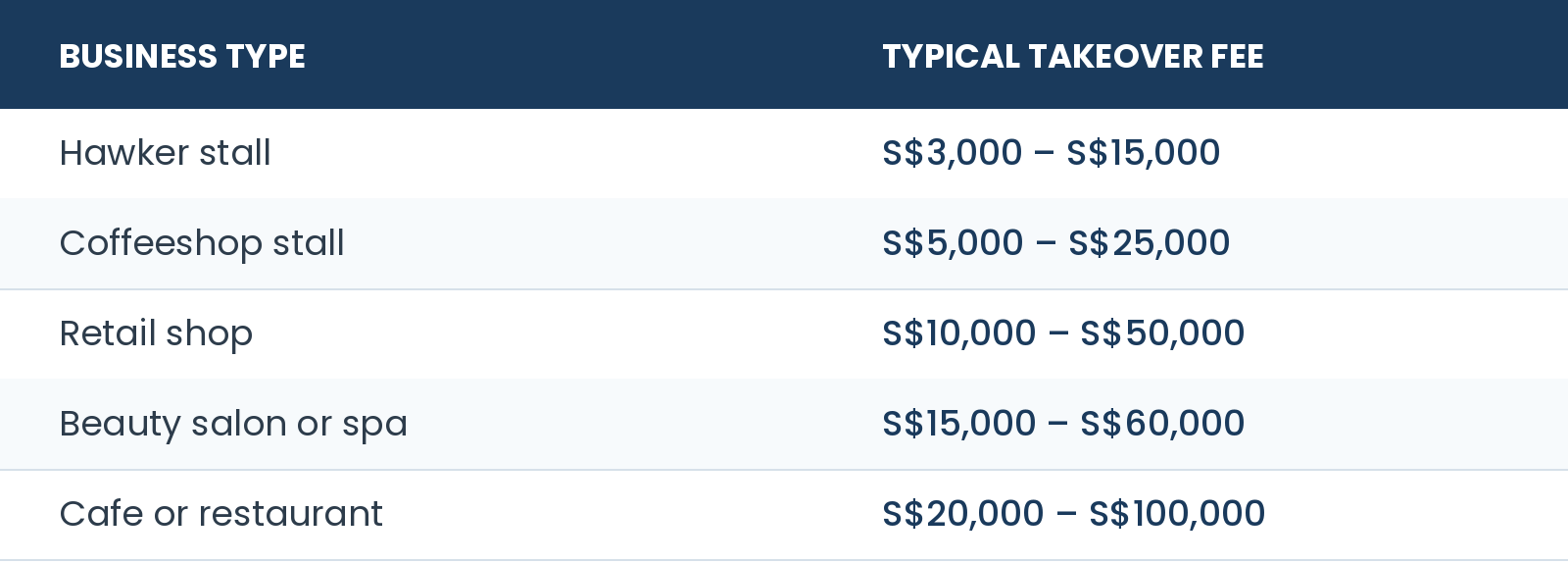
The figures in the table above are illustrative, not benchmarks. Low-end figures around S$3,000 usually refer to private coffeeshop, food-court or similar fitted stalls with a modest fit-out — not NEA-managed hawker stalls. Cooked-food stalls in NEA hawker centres are generally awarded by tender and cannot be sold, sublet or assigned; treat any "hawker stall for sale" claim with caution and read Can You Take Over a Hawker Stall in Singapore? plus how to value a hawker stall. Private stalls that can change hands still need landlord approval and a fresh SFA food stall licence. For coffeeshop and kopitiam deals, see buying a coffeeshop in Singapore.
A fitted restaurant sits at the top of the illustrative band because the buyer inherits a full commercial kitchen, grease trap, ventilation, and premises already built to SFA requirements, all of which would take months to replicate.
Anything above these bands is not automatically unfair. A cafe near Orchard with 60 seats and four years of lease remaining may justify a figure well past S$100,000. What matters is whether the seller can show you the arithmetic behind it.
Takeover fee, asking price and valuation are three different numbers
Listings use these terms loosely, and buyers lose money on the confusion.
A takeover fee is what you pay to assume the lease and the assets. An asking price is what the seller wants in total, which may bundle the takeover fee together with stock, deposits, and outstanding renovation loans. A valuation is an estimate of what the business is worth based on its earnings, usually worked out as a multiple of normalised yearly profit. There is no official multiple, so it has to be supported by the business's own records. To set or test an asking price, see how much to sell a business for. For the wider method, see business valuation in Singapore.
A profitable business is generally priced on valuation. A break-even or loss-making one is priced on what the lease and physical assets are worth. If a seller quotes a valuation-based number for a business that has never turned a profit, you are paying for optimism.
If you are still mapping the full purchase process, start with how to buy a business in Singapore.
What moves the fee up or down
Remaining lease term is the single biggest factor. A tenancy with six months left is worth a fraction of one with three years and a renewal option, because the buyer may have to walk away from every dollar of fit-out if the landlord declines to renew.
Landlord approval matters just as much. Most commercial tenancies in Singapore require the landlord's written consent to assign or novate the lease. A seller who has not confirmed that consent is selling something they may not be able to deliver.
Licence transferability affects F&B deals in particular. An SFA food shop licence does not travel with the premises. The incoming operator applies in their own name, and any outstanding rectification order or hygiene grading issue becomes their problem. See the full process in our SFA licence transfer guide for F&B buyers.
Equipment age rarely gets checked properly. A five-year-old commercial chiller near the end of its service life is a cost, not an asset. Ask for purchase dates and servicing records.
Verified revenue changes everything. Sellers who can produce twelve months of POS reports, bank statements, and IRAS filings command higher fees and close faster, because the buyer is no longer guessing.
How to check whether a fee is fair
Work out the rebuild cost first. Get a rough quote for the renovation and equipment as if you were starting from scratch in a comparable unit. If the takeover fee exceeds that number, the seller is charging you for goodwill, and goodwill needs evidence.
Then work out the payback. Divide the fee by the business's verified monthly net profit to see how many months it would take to earn the fee back, and compare that with the lease you are getting. No official rule says how many months is fair, but if the payback runs past the remaining lease and any renewal option, you may be paying for profit you never get the chance to earn.
A real example: the Robinson Road sports bar above asked S$180,000, with the seller stating yearly profit of S$120,000, about S$130,000 of stock included, and two and a half years left on the lease. On the seller's figures that is about 18 months of profit, inside the remaining lease. But most of the price is stock, so count and value it, and verify the profit, before you agree the number.
Check the lease maths separately. Multiply the monthly rent by the months remaining. A S$6,000 rent with eight months left is a S$48,000 commitment before you earn a cent, and that liability sits alongside the takeover fee rather than inside it.
Ask what happens to the staff. When a business is transferred, section 18A of the Employment Act generally moves employees' contracts to the buyer on the same terms, their service counts as continuous, and the seller's obligations under those contracts pass to the buyer. Vague staffing arrangements at handover create costs that surface after you have paid. See our guide to taking over staff in a business takeover.
How and when the fee is paid
A common sequence for Singapore takeover deals is a good-faith deposit of 5 to 10 per cent, which holds the business while the buyer completes checks. The balance is paid on handover day, once the lease assignment is signed and the landlord has acknowledged the incoming tenant.
Pay by bank transfer so there is a record, and get a signed handover list covering every item included in the fee. Verbal inclusions have a habit of disappearing between the viewing and the handover.
Stock is usually counted and paid for separately on the day, at cost price rather than retail. Agree that method before you agree the fee, because a S$12,000 stock bill arriving late changes the economics of a S$30,000 deal.
If the seller wants the full amount before the landlord has confirmed the assignment, stop. That sequencing mistake is how buyers end up paying for a lease they never receive.
Red flags worth walking away from
-
A seller who will not name a figure until you have viewed the premises twice.
-
A seller who cannot produce a tenancy agreement in their own name.
-
A fee described as negotiable that never actually moves.
-
Equipment sold as included that turns out to be on a rental or leasing contract.
-
A refusal to show any financial record at all.
-
A listing that frames an NEA hawker centre stall as something you can buy or take over from the current holder.
The last financial warning is still the clearest for most deals. Sellers who genuinely have a profitable business are usually keen to prove it, because the proof is what justifies the price.
This guide is general information, not financial, tax or legal advice.
You can browse current business listings across all categories on SG Business Mart and compare quoted takeover fees against the ranges in this guide. Every listing connects you directly with the owner, with no broker and no commission on either side.

Frequently asked questions
What is a fair business takeover fee in Singapore?
There is no official benchmark. A fair fee is one you can tie back to the remaining lease, the fit-out and equipment, and any verified profit. On SG Business Mart's F&B listings in October 2026, asking fees ran from S$8,000 for a food stall to S$180,000 for a fitted sports bar. NEA-managed hawker stalls generally cannot be sold or assigned.
Is a takeover fee the same as the asking price?
No. The takeover fee covers the lease, fittings and equipment you inherit. An asking price may also include stock, security deposits and outstanding loans, so always ask the seller for an itemised breakdown.
Can I negotiate a business takeover fee?
Yes. Takeover fees in Singapore are usually negotiable, particularly where the lease has under 12 months remaining, the equipment is ageing, or the business has been listed for several months without a buyer.
How do I know if a takeover fee is too high?
Compare it with two numbers: the cost of building the same setup from scratch, and how many months of verified net profit it would take to earn the fee back. If the fee is well above the rebuild cost, the payback runs past the remaining lease, and no verified earnings support it, it is too high.
How many months of profit should a takeover fee be?
There is no official rule. Work out the payback: divide the fee by verified monthly net profit and compare the result with the remaining lease and any renewal option. If you would need longer than the lease to earn the fee back, push back on the price. Separate stock and deposits from the fee first.
Do I still pay a takeover fee if the business is not profitable?
Usually yes, but the fee should be based on the value of the lease and the physical assets rather than on earnings. A loss-making business priced on a profit multiple is priced incorrectly.
What should I check before paying a takeover fee in Singapore?
Confirm the landlord has agreed in writing to the lease assignment, check the remaining tenancy term, verify equipment condition and age, and confirm which licences must be reapplied for in your own name (SFA licences do not transfer with the premises).