How to Value a Hawker Stall in Singapore
You are not buying a recipe. You are buying a lease, a set of equipment, and the hours it takes to run them.
Check whether the stall can even be sold
This is the step almost every first-time buyer skips, and it changes everything. Not all hawker stalls can be legally taken over.
Cooked food stalls inside NEA-managed hawker centres are awarded by open tender and are not transferable. You cannot buy one from the current holder, and any arrangement to pay someone to hand over an NEA stall breaches the tenancy. If a listing describes a stall inside a government hawker centre as being for sale, treat that as a red flag and ask exactly which entity holds the tenancy.
The stalls that genuinely change hands are in coffeeshops, food courts, and private kopitiams, where a landlord or operator owns the unit and can approve a new tenant. Here the takeover is real, the equipment transfers, and the valuation methods below apply. Confirm which type you are looking at before you discuss price.
The three things a hawker stall's value is built from
Profit is the largest piece. A hawker stall is bought for the income it produces, so the starting point is verified monthly net profit after rent, ingredients, utilities, and any hired help. Net profit, not daily takings. A stall taking S$800 a day sounds strong until you subtract S$4,500 rent, ingredient cost, and a helper's wages.
Equipment sets a floor. A wok station, chiller, display counter, exhaust hood, and prep tables have real second-hand value. Even a barely profitable stall is worth the used value of its fit-out, because the buyer avoids building it. Value equipment at replacement cost for used items, never at what the seller originally paid.
Goodwill is the hardest to price. A stall with a daily queue, strong delivery-platform ratings, and a recipe that does not depend on the owner carries genuine goodwill. A stall whose regulars come for the owner's face and cooking carries very little, because that walks out the door on handover day.
Working out the number, step by step
Take the verified monthly net profit and apply a multiple. Small owner-run food stalls in Singapore usually sell for 6 to 24 months of net profit. The heavier the owner's personal involvement, the lower the multiple, because the buyer is taking on the labour as well as the business.
Add the second-hand value of the equipment, then add any deposit the landlord agrees to transfer. The result is a fair range to open negotiation from.
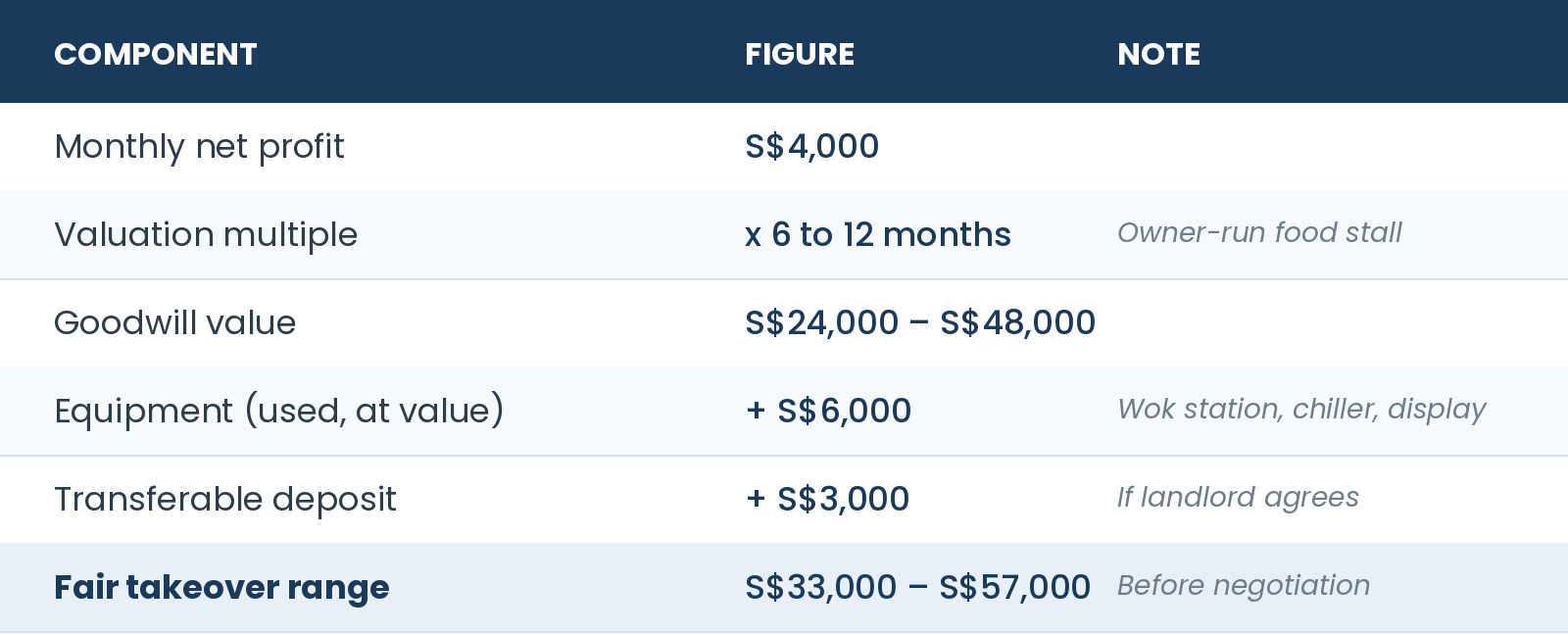
The example above uses a 6 to 12 month multiple because it assumes an owner-run stall. A stall run entirely by hired staff, with the owner absent, would justify a higher multiple, since the buyer inherits a system rather than a job. The equipment and deposit lines are added on top of goodwill, not blended into it.
For the wider picture on how Singapore buyers assess price and structure a deal, see our guide on selling a business in Singapore the right way.
What pushes the value up
-
Verified takings. Three or more months of POS reports and bank records let a buyer trust the profit figure, which supports a higher multiple.
-
A longer tenancy. A stall with two years of tenancy plus a renewal option is worth far more than one with four months left.
-
Staff who stay. A stall that runs on trained helpers rather than the owner's own hands transfers as a working system.
-
Delivery presence. Established GrabFood or foodpanda listings with ratings and order history carry real transferable value.
-
A recipe that travels. A central sauce or process that anyone competent can follow protects the income after the owner leaves.
What pulls the value down
Short remaining tenancy is the most common value killer. If the buyer may have to vacate within months, the equipment and goodwill are worth a fraction of their headline value.
Owner dependence is the quiet one. Many hawker stalls are profitable only because the owner works twelve-hour days and pays themselves nothing. Strip in a fair wage for the hours worked, and the real net profit often shrinks. Price on that adjusted figure, not the seller's.
Ageing equipment is a cost dressed up as an asset. A chiller near the end of its life is a future bill. Ask for purchase dates and recent servicing before you credit any equipment value.
Unverified numbers deserve caution. A cash-heavy stall with no records is asking you to take the profit on trust. When the numbers cannot be checked, price on the equipment and lease alone and treat any goodwill as a bonus.
The rent-and-hours reality check
Two numbers decide whether a hawker stall is worth its asking price, and both are easy to gloss over. The first is rent as a share of takings. A stall paying S$4,500 rent on S$18,000 of monthly sales is already handing a quarter of every dollar to the landlord before ingredients. If the next tenancy resets higher, the profit the valuation rests on shrinks with it.
The second is the owner's own labour. A stall that nets S$4,000 a month on the owner working seventy hours a week is really paying that owner below market wage for the hours. Cost in a fair salary for those hours and the true profit can halve. Buy on that adjusted figure, because it is the profit you will actually keep once you value your own time honestly.
Common mistakes buyers make
Paying on revenue instead of profit is the costliest. A busy-looking stall can still be barely breaking even once rent and ingredients are counted.
Forgetting the licence is next. An SFA food shop or hawker licence does not transfer with the stall. The incoming operator reapplies in their own name, and any hygiene grading or rectification order becomes theirs to resolve.
Ignoring the rent trajectory catches many buyers. A tenancy up for renewal may reset to a higher rate, which changes the profit the valuation was built on. Confirm the next rent, not just the current one.
When you are ready to compare real asking prices, you can browse current F&B and hawker listings on SG Business Mart and test each one against the method in this guide. Every listing connects you directly with the owner, with no broker in between.

Frequently asked questions
How much is a hawker stall worth in Singapore?
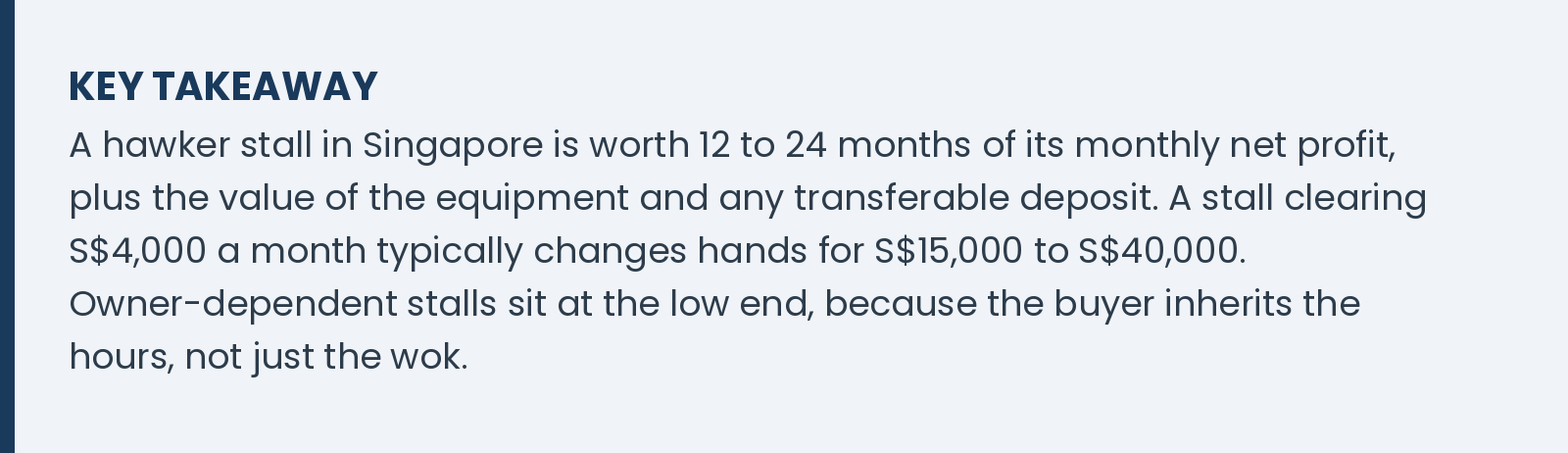
Most hawker and coffeeshop stalls change hands for between S$3,000 and S$40,000, depending on monthly profit, equipment and remaining tenancy. A stall clearing around S$4,000 a month typically values at 12 to 24 months of that profit plus the equipment.
Can you buy an NEA hawker centre stall directly?
No. Cooked food stalls in NEA-managed hawker centres are awarded by open tender and cannot be sublet or sold on the open market. Most stalls advertised for takeover are in coffeeshops, food courts or private kopitiams, where the landlord can approve a new operator.
What multiple is used to value a hawker stall?
Small owner-run food stalls usually sell for 6 to 24 months of net profit. Stalls that depend heavily on the current owner's cooking or presence sit at the lower end, because the buyer inherits the workload as well as the income.
Does the equipment affect a hawker stall's value?
Yes. Commercial equipment such as a wok station, chiller, display counter and exhaust hood sets a floor on the price. Value it at second-hand replacement cost, not the price the seller originally paid, and check the age and servicing of any chiller or freezer.
Why do some hawker stalls sell so cheaply?
A low takeover price usually reflects short remaining tenancy, ageing equipment, thin or unverified profit, or a business that only works because the owner puts in long hours. In those cases the buyer is mostly paying for the fit-out and the chance to trade, not for stable earnings.
What should I check before buying a hawker stall in Singapore?
Confirm the tenancy terms and remaining period, check whether the landlord or coffeeshop operator approves the transfer, verify the SFA licence must be reapplied for in your name, review at least three months of takings, and inspect the equipment condition before agreeing a price.

