How to Buy a Coffeeshop in Singapore
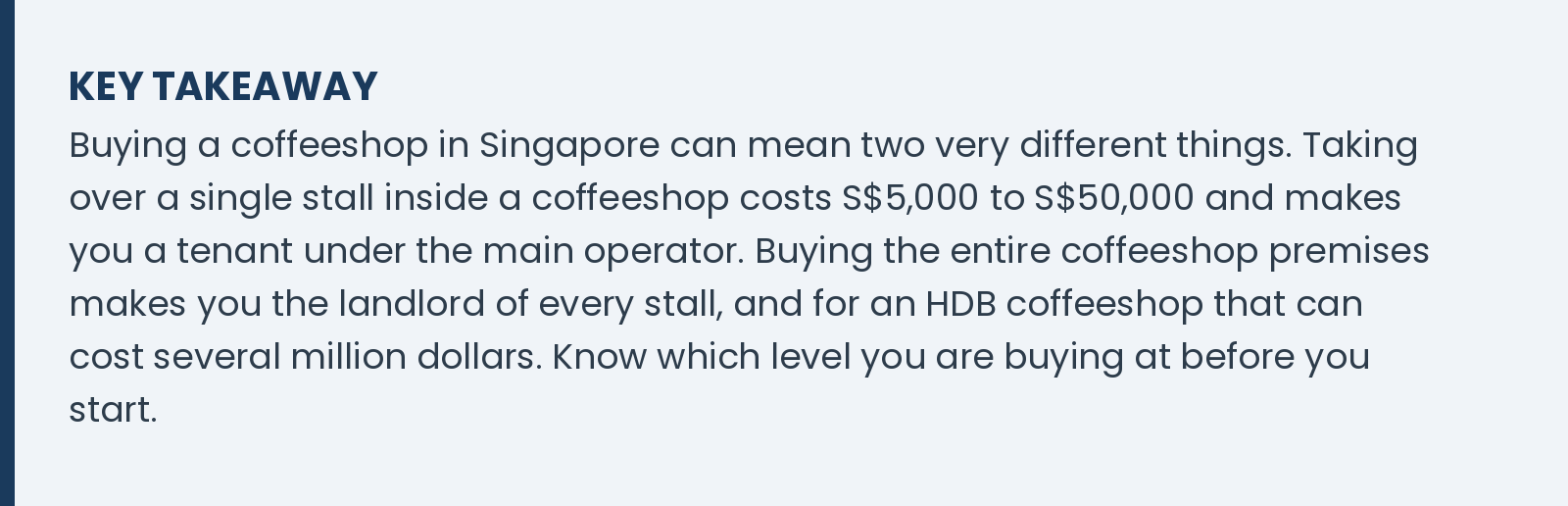
Buying a coffeeshop in Singapore can mean two very different things. Taking over a single stall inside a coffeeshop costs S$5,000 to S$50,000 and makes you a tenant operating under the main coffeeshop operator. Buying the entire coffeeshop premises makes you the operator of every stall, and for an HDB coffeeshop that can cost several million dollars. This guide covers both levels, because mixing them up is the most expensive mistake a first-time buyer can make.
A stall inside a coffeeshop and the coffeeshop itself are two completely different businesses at two completely different price points.
The two levels of buying a coffeeshop
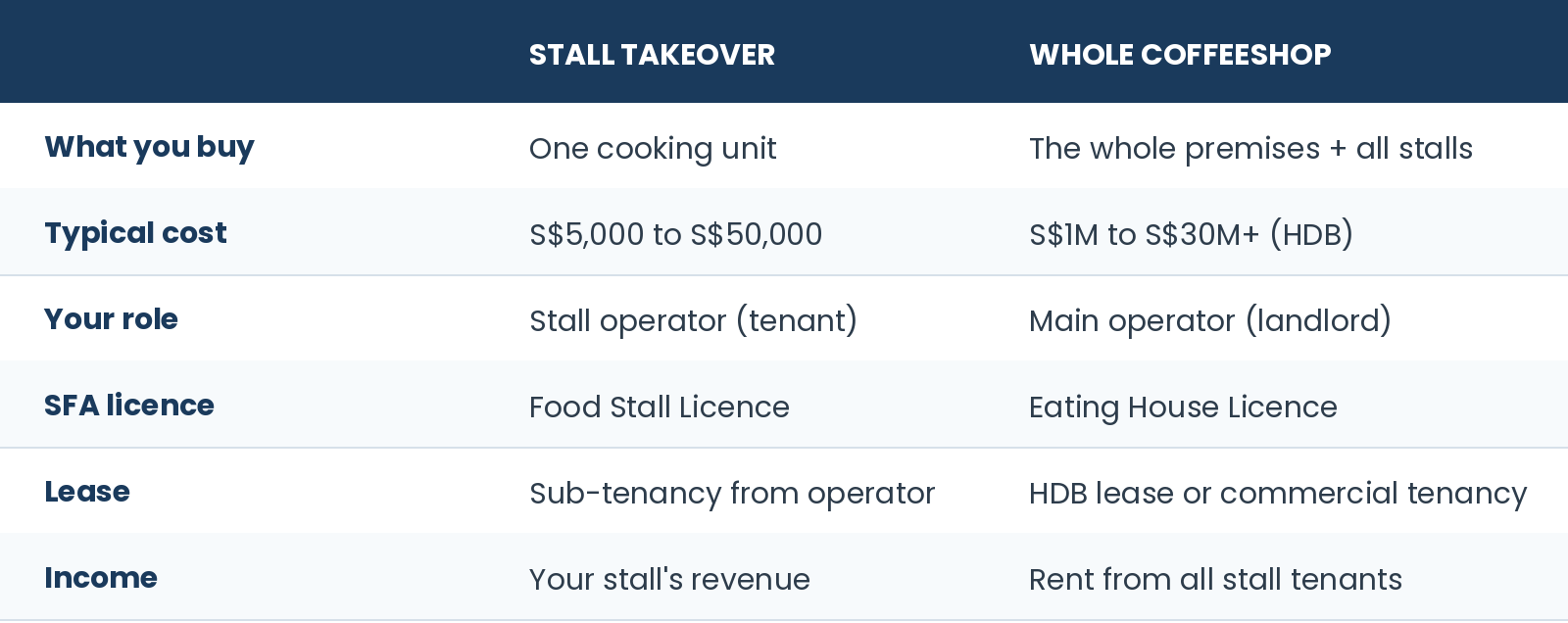
Most buyers searching for a coffeeshop on a marketplace are looking at the stall level. Most investors looking at the premises level work through property agents or direct deals. Both show up under the same keyword, which is why the distinction matters before you spend time on any listing.
Buying a stall inside a coffeeshop
A coffeeshop stall takeover works like any small F&B takeover, with one extra layer: the coffeeshop operator sits between you and the premises. The operator holds the eating house licence and the main tenancy. You hold a sub-tenancy and your own SFA Food Stall Licence.
The operator must approve the incoming stall tenant. A signed deal with the outgoing stall holder is worthless without the operator's written consent, just as a standard takeover is worthless without the landlord's consent. Confirm the operator's approval before you pay anything.
Check the sub-tenancy terms carefully. Coffeeshop operators set the rent, the operating hours, and sometimes the type of food each stall can serve. Some operators include drink-stall exclusivity clauses that restrict which beverages you can sell. A stall priced at S$20,000 with rent at S$4,000 per month and a two-year sub-tenancy is a very different proposition from one priced at S$20,000 with rent at S$2,500 and a four-year term.
For how takeover fees are structured and how to test whether one is fair, see our guide to business takeover fees in Singapore.
What to check before taking over a stall
-
Remaining sub-tenancy. A stall with three months left and no renewal guarantee is worth a fraction of one with two years remaining. The operator can choose not to renew, and your fit-out investment walks out the door with it.
-
Rent and rent reviews. Ask what the current rent is, when it was last reviewed, and what the next increase is likely to be. Some operators reset rent to market rate at renewal, which changes the profit the takeover fee was based on.
-
Operating restrictions. Confirm what food you can sell, whether the operator restricts delivery platform use, and whether there are shared-facility rules for washing, waste, or storage.
-
Equipment condition. Walk the stall and check every chiller, burner, exhaust hood, and display unit. Ask for purchase dates. Equipment that looks functional but is near the end of its service life is a cost you inherit.
-
Existing delivery presence. A stall with established GrabFood or foodpanda listings and reviews carries transferable value. A stall with no delivery presence starts from zero on those platforms.
Buying the whole coffeeshop premises
Buying the entire coffeeshop is a property investment, not an F&B takeover. You become the main operator. Your income comes from the rent your stall tenants pay, not from cooking and selling food yourself.
HDB coffeeshops are sold on long leases, typically 30 years granted by HDB. When the lease changes hands, it transfers at the agreed price. Recent HDB coffeeshop sales in Singapore have ranged from under S$1 million for smaller units in quieter estates to over S$30 million for large, well-located premises. The value is driven by stall count, the remaining lease term, the rental yield from existing tenants, and the footfall from the surrounding HDB blocks.
Private coffeeshops in commercial buildings operate on standard commercial tenancies. The buyer negotiates a new tenancy or takes over the existing one, and the price reflects the rental income, lease security, and location.
At this level, you need a property lawyer, a clear view of the tenancy obligations, and the capital to manage a multi-tenant food establishment. The SFA licence you hold is the Eating House Licence, which covers the premises as a whole, not individual stalls.
The rent-to-revenue question
Coffeeshop stall rent in Singapore varies widely, from under S$2,000 a month for a small stall in a quieter estate to over S$5,000 for a well-located unit with strong footfall. The rent is the single biggest fixed cost the stall carries, and it is set by the operator, not by you.
Before you agree a takeover fee, divide the monthly rent by the average daily revenue to see what share of every dollar goes to the operator. A stall paying S$3,500 rent on S$12,000 of monthly revenue is handing nearly 30% to the landlord before ingredients, helpers, and utilities. If the rent review at renewal pushes that higher, the margins the takeover fee was priced on may no longer hold.
Coffeeshop versus hawker centre versus food court
These three are often confused, and the confusion has real consequences for what you can buy.
A coffeeshop is privately or HDB-owned. Stalls are sub-let by the main operator, and takeovers happen on the open market with the operator's consent. A hawker centre is typically managed by NEA or a Social Enterprise appointed by NEA. Stalls are allocated by open tender, not sold, and cannot be transferred on the open market. A food court is commercially operated, often by a chain, and stall placements are negotiated directly with the food court operator.
If a listing describes a stall as being in a coffeeshop, confirm that it is genuinely a coffeeshop and not a hawker centre with a similar layout. The difference determines whether the stall can legally change hands at all.
When you are ready to compare what is available, browse coffeeshop and F&B listings on SG Business Mart and enquire directly with sellers. No broker, no commission.

Frequently asked questions
How much does it cost to buy a coffeeshop stall in Singapore?
A stall takeover in a coffeeshop typically costs S$5,000 to S$50,000, depending on the location, the equipment included, the remaining sub-tenancy, and whether the stall has an established customer base and delivery-platform presence.
How much does it cost to buy an entire coffeeshop?
HDB coffeeshop premises on long leases have sold for S$1 million to over S$30 million, depending on the number of stalls, the location, and the remaining lease term. Private coffeeshops in commercial buildings are priced on their rental yield and tenancy terms.
What licence do I need to run a coffeeshop stall?
You need an SFA Food Stall Licence, not a Food Shop Licence. The food stall licence covers individual stalls within a coffeeshop, food court, canteen, or hawker centre. You apply through GoBusiness in your own name.
Does the coffeeshop operator have to approve my takeover?
Yes. The main operator or landlord must approve the incoming stall tenant before the sub-tenancy can be assigned. A signed deal with the outgoing stall holder is worthless without the operator's written consent.
Can foreigners buy a coffeeshop stall in Singapore?
A foreigner can take over a coffeeshop stall by setting up a Singapore company, but the practical requirement is a work pass if you intend to run the stall yourself. The operator must also agree to the new tenant entity.
What is the difference between a coffeeshop and a hawker centre?
A coffeeshop is a privately or HDB-owned eating establishment where the operator rents out individual stalls. A hawker centre is typically managed by NEA or a Social Enterprise, and stalls are allocated by tender rather than sold on the open market. Most coffeeshop stalls can be taken over, while NEA hawker stalls cannot.

