How to Verify a Seller's Financials Before You Buy
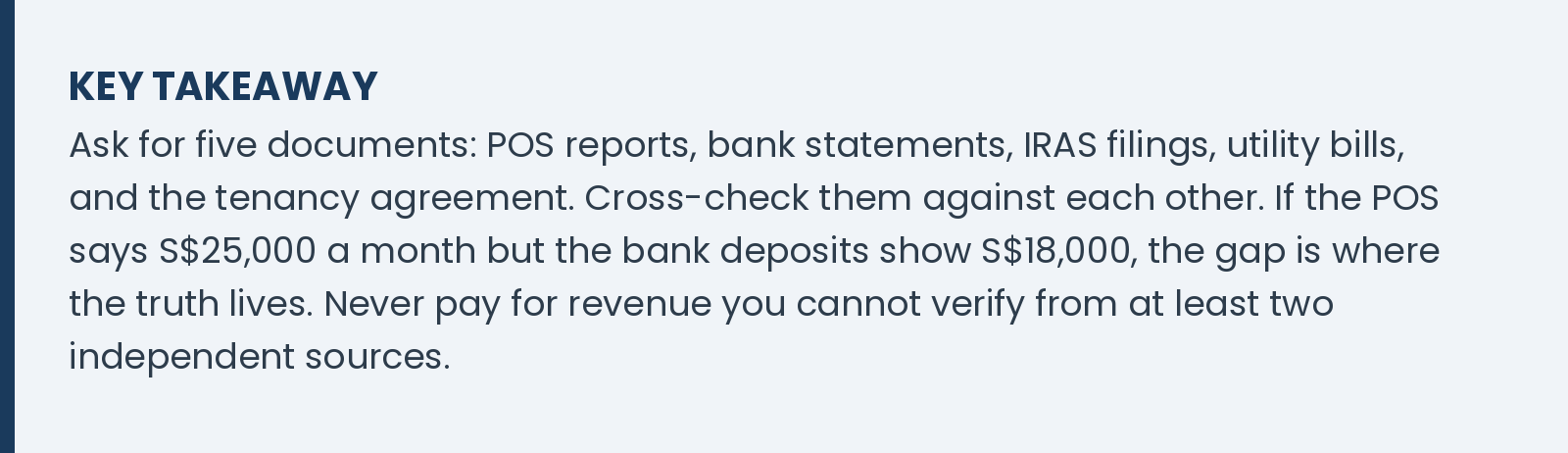
The single most expensive mistake when buying a business in Singapore is paying for revenue you cannot verify. Five documents, cross-checked against each other, tell you whether a seller's numbers are real: POS reports, bank statements, IRAS filings, utility bills, and the tenancy agreement. If the POS says S$25,000 a month but the bank deposits show S$18,000, the gap is where the truth lives. This guide shows you what to ask for, how to read each document, and what the mismatches mean.
One document proves nothing. Two documents that agree prove something. Two documents that disagree tell you everything.
The five documents and what each one tells you
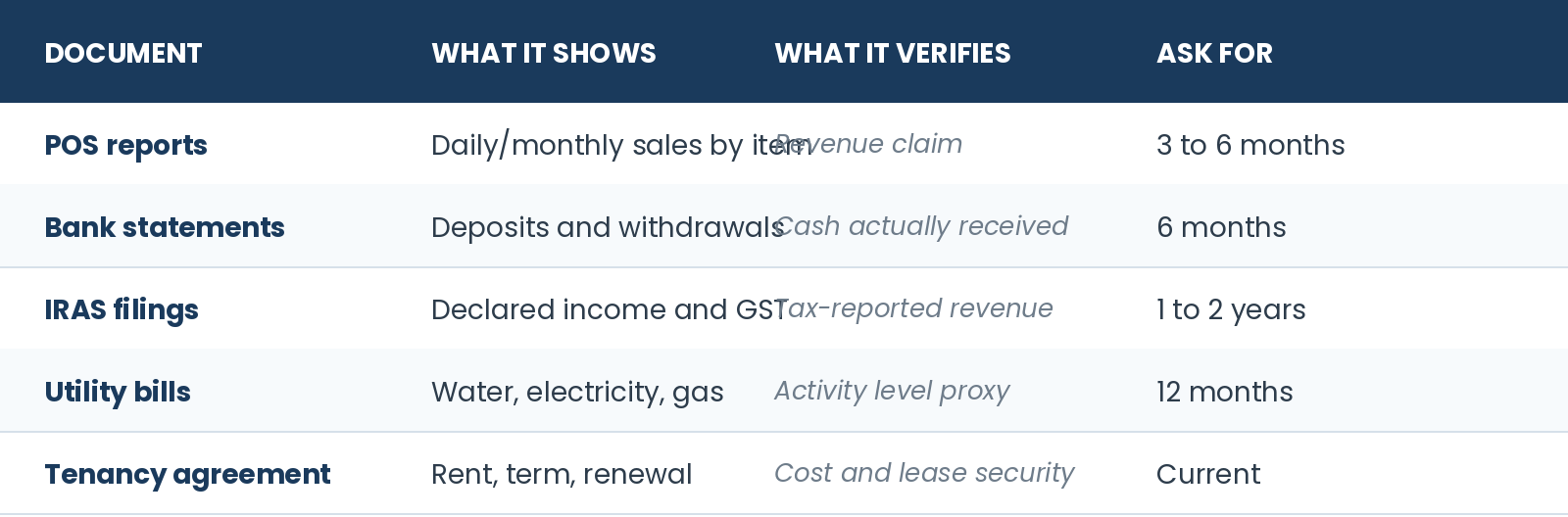
No single document is reliable on its own. A POS report can be edited. A bank statement can reflect deposits from multiple sources. An IRAS filing covers a full year and may not match the recent months the seller is quoting. The power is in the cross-check: documents that agree give you confidence; documents that contradict each other tell you where to look harder.
POS reports: what the system recorded
A POS (point-of-sale) system logs every transaction, usually broken down by date, time, item, and payment method. Ask for three to six months of daily reports. What you are looking for is consistency: a business that claims S$800 per day should show that pattern across ordinary weekdays, not just weekends and holidays.
Check the split between cash and cashless payments. A business where 80% of transactions are cash and only 20% are digital has a larger portion of revenue that cannot be independently verified. A business where most revenue flows through PayNow, credit cards, or GrabPay has a digital trail that matches the bank statement.
Ask whether the POS data can be exported directly, or whether the seller is showing you a summary they compiled. Raw system exports are harder to alter than a spreadsheet the seller created.
Bank statements: what actually arrived
The bank statement is the hardest document to fake and the most revealing. Request six months of statements for the business account. Total the deposits and compare them to the POS total for the same period. The two numbers should be close. A significant gap, typically more than 10 to 15%, signals either unreported cash, discounts not captured in the POS, or inflated POS figures.
Look at the outgoing payments as well. Rent, supplier payments, utility direct debits, and loan repayments all appear on the statement. These give you an independent view of the cost structure without relying on the seller's word.
For how revenue and costs affect the takeover fee, see our guide to business takeover fees in Singapore.
IRAS filings: what the seller told the taxman
If the business files income tax returns or GST returns with IRAS, those filings declare the revenue the seller reported to the government. Ask for the last one to two years. A seller who tells you the business earns S$30,000 a month but declared S$15,000 a month to IRAS has a credibility problem in both directions: either they understated to IRAS, which is a tax compliance risk you inherit in a share purchase, or they are overstating to you.
Not every small business has formal IRAS filings beyond the annual tax return. Sole proprietors may not file GST if below the S$1 million threshold. If filings are not available, lean more heavily on the POS-to-bank cross-check.
Utility bills: the silent witness
Utility bills are an independent, third-party record of how much the business actually operates. A restaurant claiming strong revenue should have water and electricity bills consistent with a kitchen running at volume. A laundromat claiming high machine utilisation should have water bills that match. A beauty salon claiming full appointment books should have electricity use that reflects dryers, steamers, and lighting running all day.
Utility bills are particularly useful for catching exaggerated claims in cash-heavy businesses where POS and bank data are thin. A seller who says the business does S$30,000 a month but has a S$200 electricity bill is describing a business that is not open very often.
The tenancy agreement: cost and security
The tenancy agreement confirms the rent, the remaining term, the renewal option, and any rent-review clauses. It is the single most important cost document because rent is usually the largest fixed expense. A business that looks profitable at S$3,000 rent may not be profitable at S$4,500 after the next review.
Check whether the tenancy is in the seller's name or a company name that matches the business. A mismatch may indicate the seller is not the legal tenant, which complicates the lease assignment. Confirm the landlord's identity and whether consent to assign has been discussed.
How to run the cross-check
Line up three months of POS totals against three months of bank deposits. If the POS shows S$75,000 in total sales and the bank shows S$68,000 in deposits over the same period, the S$7,000 gap is either cash that never reached the bank, staff discounts and voids, or platform commission deductions. Ask the seller to explain the gap. A reasonable explanation, backed by evidence, is fine. No explanation, or an explanation that shifts each time you ask, is a warning.
Then check the claimed monthly profit against the bank statement's outgoings. Subtract rent, supplier payments, and utilities from the bank deposits. The residual should be close to the profit figure the seller quoted. If it is not, the cost side of the equation is wrong and the business is less profitable than presented.
For deals above S$50,000 or any deal involving a share purchase, consider paying an accountant for a few hours of review. The cost is modest and the accountant will spot patterns in the numbers that a first-time buyer may miss.
When you are ready to apply this method, browse businesses for sale on SG Business Mart and enquire directly with owners. Ask for the five documents before you agree any price.

Frequently asked questions
What documents should I ask for before buying a business?
Ask for POS reports covering at least three months, six months of bank statements, one to two years of IRAS filings if available, twelve months of utility bills, and the current tenancy agreement. Cross-check these against each other rather than relying on any single document.
How do I tell if revenue figures are genuine?
Compare the POS total to the bank deposits for the same period. Genuine revenue flows through both. A gap between POS-reported sales and actual bank deposits suggests cash leakage, unreported discounts, or inflated POS figures. The bank statement is harder to fake than a POS report.
Should I trust a seller who only has cash records?
Treat cash-only records with extra caution. A business with no POS system and no digital payment trail relies entirely on the seller's word for its revenue. Price on the equipment and lease value rather than on claimed profit, unless the seller can provide bank deposits or IRAS filings that corroborate the numbers.
What do utility bills tell me about a business?
Utility bills are an independent proxy for activity level. A restaurant claiming S$30,000 in monthly revenue should have electricity and water bills consistent with a kitchen running at that volume. A bill that suggests minimal usage contradicts the revenue claim.
Can I verify financials without an accountant?
For a small takeover under S$50,000, most buyers can do the cross-check themselves using the five-document method. For larger or more complex deals involving a share purchase, company debts, or multiple revenue streams, engaging an accountant for a few hours of review is worth the cost.
What if the seller refuses to provide financial records?
A refusal is itself the answer. A seller who will not let you see the numbers is asking you to pay for revenue you cannot verify. Walk away or price the deal on the equipment and lease alone, with zero goodwill, and see whether the seller reconsiders.

