Buy a Business or Start From Scratch in Singapore?

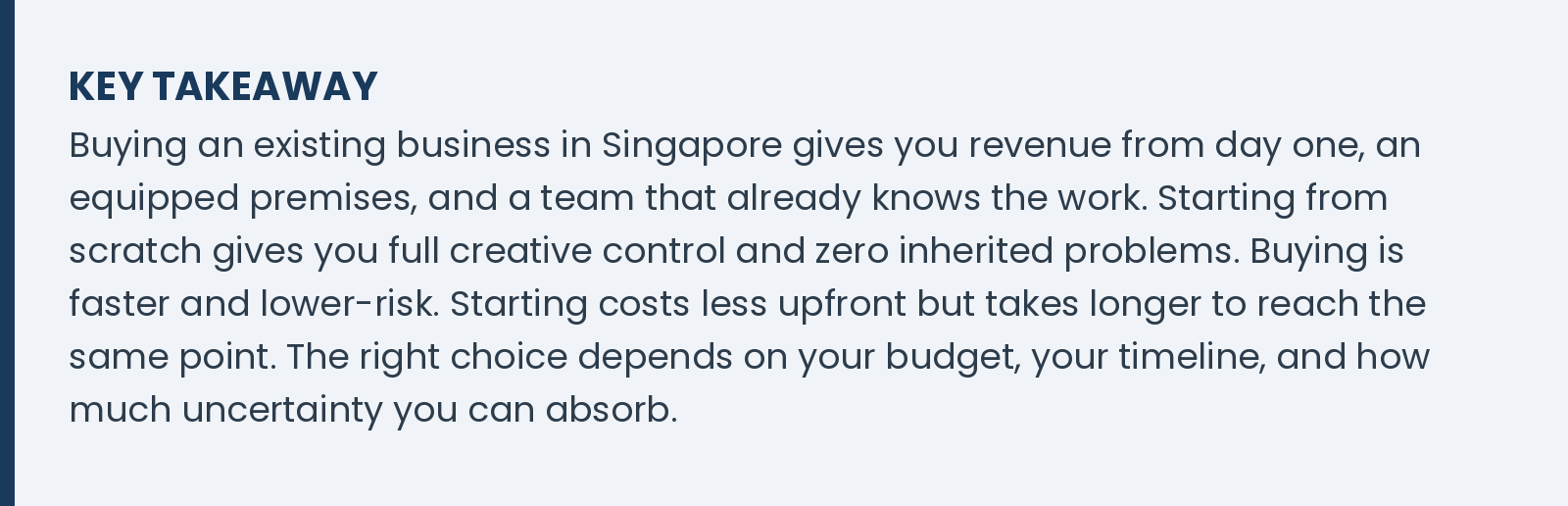
Buying an existing business in Singapore gives you revenue from day one, an equipped premises, trained staff, and an established customer base. Starting from scratch gives you full creative control, zero inherited problems, and a lower upfront cost, but it takes six to eighteen months to reach the same point. Buying is faster and lower-risk when a suitable business already exists. Starting is the only option when your concept is genuinely new. This guide compares both paths on cost, time, risk, and control so you can decide which fits your situation.
Buying skips the hardest part of business ownership: the first year of building from nothing.
The comparison at a glance
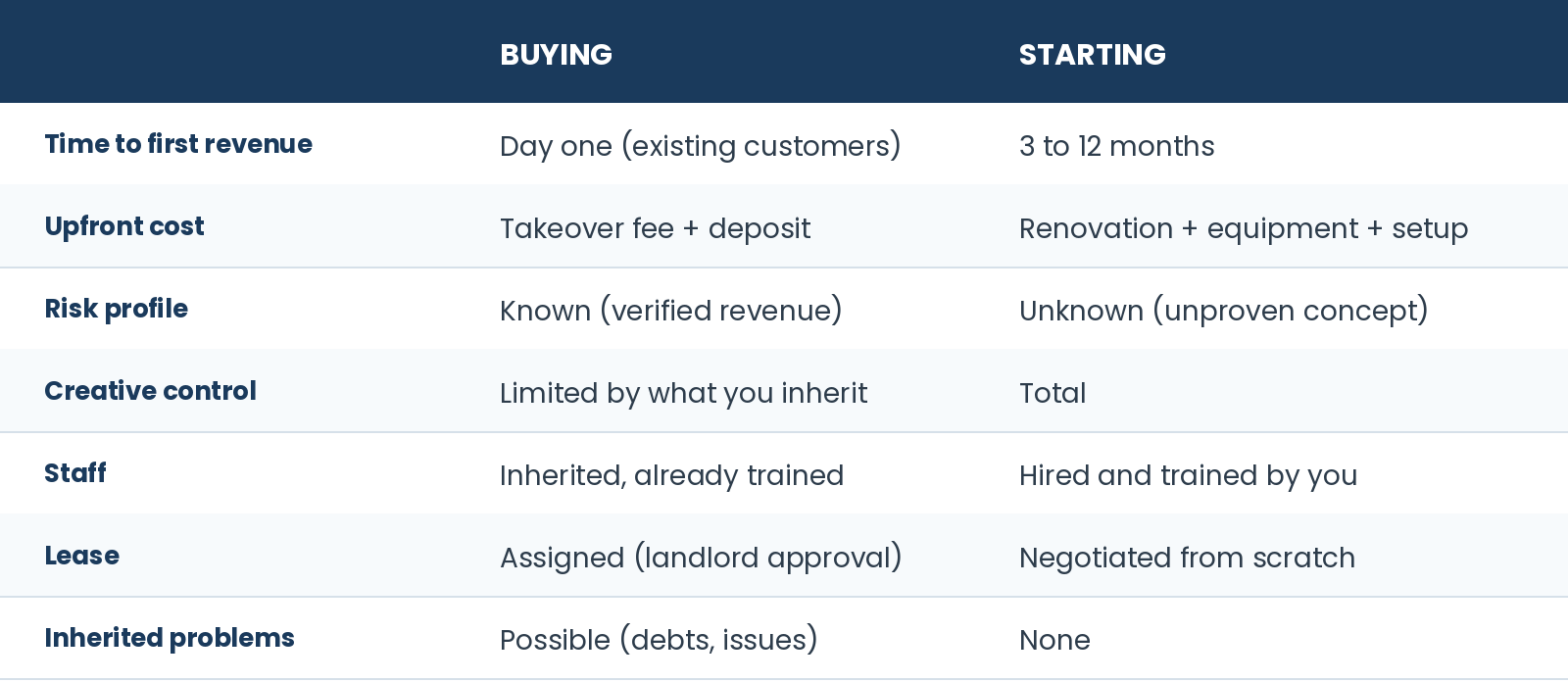
Every row in the table above represents a genuine trade-off. Buying is not universally better than starting, and starting is not universally cheaper than buying. The right choice depends on which trade-offs you are willing to accept.
The cost comparison
Buying has a higher upfront cost because the takeover fee bundles the fit-out, equipment, lease, and goodwill into a single payment. A cafe takeover at S$40,000 includes a kitchen that would cost S$60,000 to build from scratch, chairs and tables worth S$8,000, and a tenancy that took weeks to negotiate. The takeover fee often represents a discount on the replacement cost of the assets.
Starting from scratch has a lower day-one outlay because costs arrive sequentially: renovation first, then equipment, then licensing, then marketing, then months of operating at a loss while revenue builds. The total spend to reach the same point as the existing business, a functioning operation with paying customers, can equal or exceed the takeover fee by the time break-even arrives.
For how takeover fees are structured and what each component is worth, see our guide to business takeover fees in Singapore.
The time comparison
An existing business generates revenue from the day you take over. The customers know where to come. The suppliers deliver on schedule. The staff open the shop in the morning. Your job is to keep it running, not to build it.
A start-up generates no revenue until you have found a location, signed a lease, completed the renovation, passed the licensing inspection, hired and trained staff, and attracted enough customers to cover your costs. For a typical F&B or service business in Singapore, that sequence takes three to twelve months. Every month before break-even is a month where you pay rent, wages, and utilities with no offsetting income.
The risk comparison
An existing business has a track record you can verify. POS reports, bank statements, and IRAS filings show you what the business actually earns. Trained staff show you that the operation works without the previous owner. A signed lease shows you that the premises is secured. None of these guarantees future performance, but they give you a baseline that a start-up does not have.
A start-up is an untested hypothesis. The location might not attract enough foot traffic. The concept might not resonate. The pricing might be wrong. The marketing might not reach the right people. Every one of these is a risk that an existing business has already resolved, for better or worse.
The control comparison
Starting from scratch gives you total control. You choose the name, the brand, the menu, the pricing, the fit-out, the suppliers, and the team. Nothing is inherited and nothing is compromised. For a buyer with a clear vision and industry experience, this creative freedom is the primary reason to start rather than buy.
Buying inherits what the previous owner built. The brand, the menu, the fit-out, and the staff are already in place. You can change them, but changing everything at once destroys the revenue you paid for. The practical approach is to run the business as-is for a month, understand what works, and then evolve it gradually. Control comes with time, not on day one.
When to buy
Buy when a suitable business already exists in the category and location you want, when you value revenue from day one over creative freedom, when you have the capital for the takeover fee and want to avoid the months of zero-income start-up phase, or when you are entering an industry for the first time and want the safety net of existing staff and systems.
When to start from scratch
Start when your concept is genuinely new and no existing listing matches it, when you have specific industry experience and a tested model you want to implement, when you want total control over every aspect from day one, or when the available listings are overpriced relative to what you could build yourself.
The hybrid approach
Some buyers do both. They buy an existing business to get the premises, the lease, and the customer base, and then gradually reshape it into their own concept over three to six months. A buyer who takes over a Western food stall and transitions it to Japanese rice bowls over a month, keeping the location, the equipment, and the lunch crowd, gets the benefits of both paths: existing infrastructure plus creative control.
The risk with the hybrid is that the transition loses the existing customers before the new concept gains its own. Do it gradually, test changes before committing fully, and keep what works until the replacement proves itself.
When you are ready to see what existing businesses are available, browse businesses for sale on SG Business Mart and compare what you could buy against what it would cost to build from scratch.

Frequently asked questions
Is it cheaper to buy a business or start one?
Starting from scratch often has a lower upfront cost because there is no takeover fee. But the total cost to reach the same point, including renovation, equipment, licensing, marketing, and months of revenue-free operation while you build a customer base, can equal or exceed the cost of buying an established business that already earns.
Is buying a business less risky than starting one?
Generally yes, provided you verify the financials. An existing business with documented revenue, trained staff, and a signed lease has a known performance baseline. A start-up has no baseline. You are betting that your concept, your location, and your execution will work, with no prior evidence.
How long does it take to break even with a new business?
Most small businesses in Singapore take six to eighteen months to reach consistent profitability when started from scratch. Buying an existing profitable business gives you cash flow from day one, which eliminates the break-even period entirely if the revenue holds.
Can I buy a business and then change it to my own concept?
Yes, but do it gradually. Run the business as-is for at least a month to understand what works, then introduce changes one at a time. Buyers who overhaul everything on day one often destroy the revenue the business had before they can replace it with their own.
What if I have a unique idea that no existing business matches?
Start from scratch. Buying is the better path when a suitable business already exists. If your concept is genuinely new and no listing comes close, starting is the only option. Consider whether a related business could serve as a platform that you adapt over time.
Should first-time owners buy or start?
Buy. A first-time owner benefits from inheriting trained staff, a working location, and an established routine. The learning curve is steep enough without also having to build the entire operation from nothing. Starting from scratch suits owners with specific industry experience and a tested concept.