Best Semi-Passive Businesses to Buy in Singapore
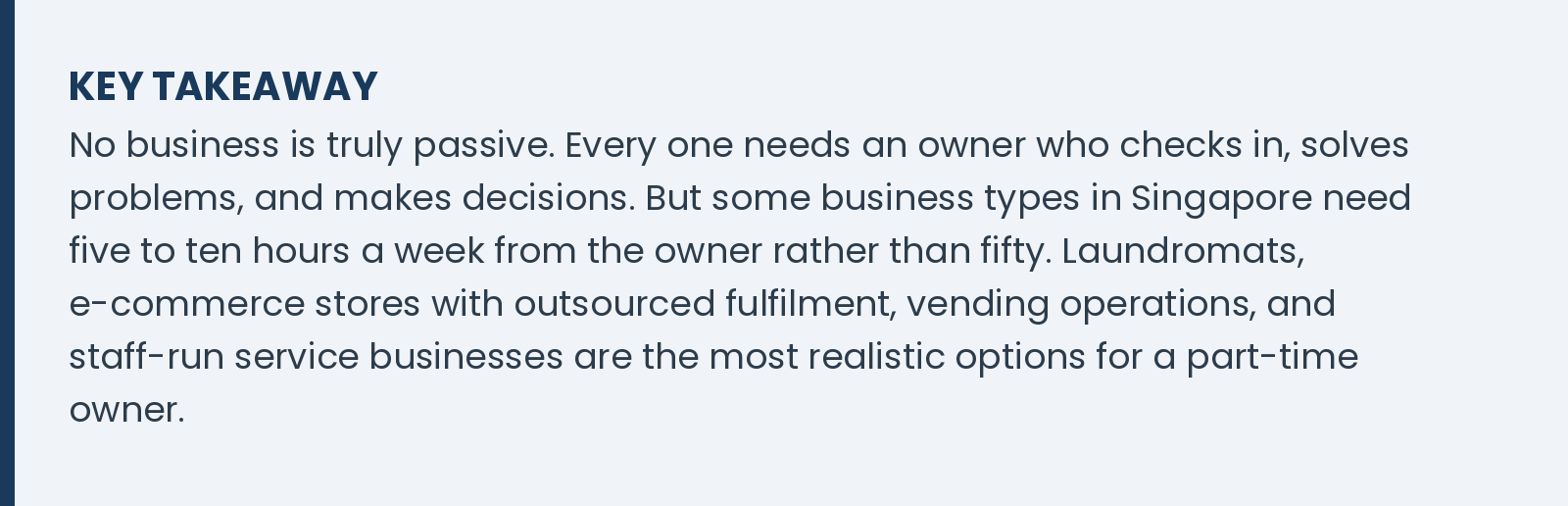
No business in Singapore is truly passive, but some need five to ten hours a week from the owner rather than fifty. Self-service laundromats, e-commerce stores with outsourced fulfilment, vending machine operations, and staff-run service businesses are the most realistic options for a buyer who wants income from ownership without full-time involvement. This guide covers each type honestly, including how many hours to expect, what the owner actually spends that time on, and why the word passive oversells what you are buying.
Semi-passive means fewer hours, not zero attention. A business you never check on is a business that deteriorates quietly.
How much time each type actually needs
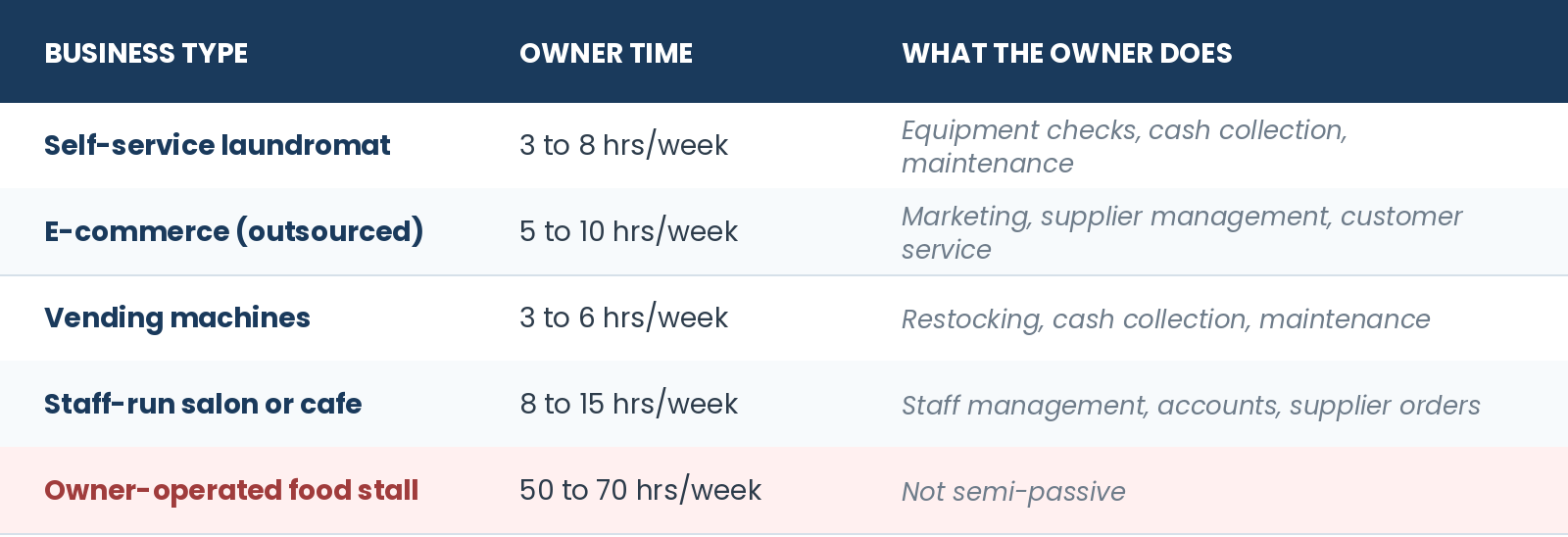
The last row is there for a reason. An owner-operated food stall is the single most common listing on the platform, and it is the opposite of semi-passive. Buyers who want part-time ownership need to filter it out early rather than discovering after the purchase that the business only works with them behind the counter every day.
Self-service laundromats
A laundromat is the closest thing to a semi-passive physical business in Singapore. The machines run on self-service. Revenue comes from machine usage, not from a service you deliver personally. Your weekly time goes to checking the machines, collecting cash or reviewing cashless transactions, scheduling maintenance, and restocking supplies like detergent if you sell it.
The risk at this owner-time level is that problems develop between visits. A machine that jams on Tuesday and is not fixed until your Saturday visit loses five days of revenue and five days of customer trust. Set up alerts from the payment system if it is cashless, and have a reliable repair contact who can respond without waiting for you.
E-commerce with outsourced fulfilment
An online store where a third-party logistics provider handles packing, shipping, and returns can run with five to ten hours of owner time per week. Your time goes to marketing decisions, supplier management, customer service escalations, and monitoring the numbers. The store takes orders and the fulfilment partner ships them without you touching a box.
The trap is that marketing is not passive. An e-commerce store without active marketing, whether paid ads, social media content, or marketplace optimisation, gradually loses visibility and revenue. The owner hours are not physical labour, but they are strategic decisions that directly affect income. Stop paying attention and the sales curve drifts downward.
For the full picture on what to check before buying an online business, see our guide to business takeover fees in Singapore.
Vending machine operations
A vending operation in Singapore, whether drinks, snacks, or speciality items, needs restocking once or twice a week depending on the location and volume. The owner drives a route, refills machines, collects cash, and handles any maintenance. Total time is typically three to six hours per week for a small cluster of machines.
What makes vending work as a semi-passive model is the absence of staff, premises rent, and operating hours. The machines sell around the clock. What makes it challenging is the location dependency: a machine in a busy MRT station or office lobby earns multiples of what the same machine earns in a quiet corridor. When buying an existing vending operation, the locations and their contracts are the value, not the machines themselves.
Staff-run service businesses
A salon, cafe, or tuition centre run entirely by hired staff with the owner handling accounts, supplier orders, and weekly check-ins sits at the higher end of semi-passive: eight to fifteen hours per week. The owner's role is management, not service delivery.
The requirement for this model to work is a team that can operate without daily supervision. A salon where the stylists handle bookings, serve clients, and close the shop independently is a semi-passive asset. A salon where the owner answers every call, resolves every complaint, and covers every absent staff member is a full-time job with an ownership title.
When buying a staff-run business for semi-passive ownership, the due diligence is about the team, not the furniture. Meet every employee. Understand their terms, their tenure, and their willingness to continue. A team that only works because the outgoing owner manages them personally will not run the same way for a part-time replacement.
What makes a business genuinely semi-passive
Three things separate a business you can run part-time from one that demands your full-time presence.
Systems that run without you. Automated payment, self-service equipment, online order processing, and scheduled supplier deliveries all remove the need for the owner to be present for each transaction. If every sale requires your personal involvement, the business is not semi-passive regardless of the label.
Staff or contractors who handle daily operations. A business with no staff and no automation has one operator: you. Hiring a manager or outsourcing fulfilment is the cost of part-time ownership, and it needs to be reflected in the profit calculation, not treated as optional.
Revenue that does not depend on your face. A salon where clients book because of the owner's personal reputation does not function when the owner steps back. A laundromat where customers come for the machines does. Match the business model to your intended involvement level before you buy.
The honest trade-off
Semi-passive businesses cost more to buy per dollar of owner income than hands-on ones, because the systems and staff that make them semi-passive are part of what you are paying for. A laundromat at S$60,000 that needs five hours a week is more expensive per hour of owner time than a hawker stall at S$10,000 that needs sixty hours, but the laundromat fits a life that includes a day job, family commitments, or other businesses.
The choice is not between good and bad. It is between how much of your time the business needs and how much of your time you are willing to give.
When you are ready to see what is available, browse businesses for sale on SG Business Mart and look for listings that describe staff-run operations, self-service models, or established systems.

Frequently asked questions
Is there such a thing as a truly passive business?
No. Every business needs someone to make decisions, solve problems, handle supplier issues, and manage the accounts. Semi-passive means five to fifteen hours a week rather than fifty. A business that needs zero hours from the owner is not a business. It is an investment, and it is priced accordingly.
Which business type needs the least owner time?
Self-service laundromats and vending machine operations need the least, typically three to eight hours a week for restocking, cash collection, and equipment checks. E-commerce with outsourced fulfilment sits slightly higher at five to ten hours. Staff-run outlets need more because managing people takes time.
Can I run a semi-passive business while keeping my day job?
Yes, and many buyers do. The key is choosing a business type that does not require your physical presence during business hours. A self-service laundromat runs during the day without you. An e-commerce store takes orders around the clock. An owner-operated hawker stall does not work alongside a 9-to-5 job.
How much do semi-passive businesses cost in Singapore?
Laundromats typically cost S$30,000 to S$100,000 depending on the equipment. E-commerce stores range from S$5,000 to S$50,000 or more. Vending operations cost S$10,000 to S$40,000 depending on the number and location of machines. Staff-run outlets such as salons or cafes sit higher because you are buying a team, not just equipment.
What makes a business semi-passive?
Three things: systems that run without the owner (automated payment, self-service equipment, online order processing), staff or contractors who handle daily operations, and a revenue model that does not depend on the owner being physically present to serve each customer.
What is the biggest risk with a semi-passive business?
Neglect. A business that runs without you for weeks at a time can develop problems that are invisible until they are expensive: machine breakdowns, staff issues, supplier changes, declining quality. Semi-passive means fewer hours, not zero attention. Check in regularly and respond quickly when something goes wrong.

