How to Negotiate a Business Price in Singapore
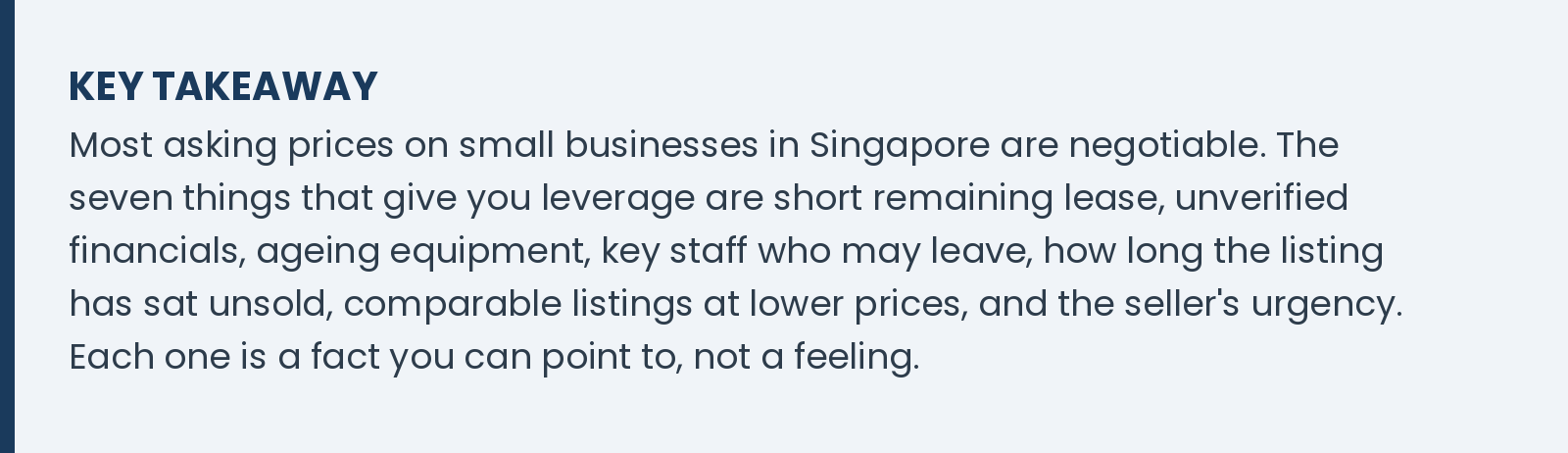
Asking prices on small businesses in Singapore are almost always negotiable. Sellers set them as opening positions, and buyers who do their due diligence before making an offer negotiate from a stronger position than those who guess. Seven specific leverage points move the number: short remaining lease, unverified financials, ageing equipment, key staff who may leave, how long the listing has sat unsold, comparable listings at lower prices, and the seller's own urgency. This guide covers each one and shows how to build an offer the seller can say yes to.
Negotiation is not about being tough. It is about knowing what the business is actually worth and being able to explain why.
Start with what the business is worth, not what it is listed for
The asking price is the seller's number. Your offer should be built from your own assessment: verified monthly profit multiplied by a reasonable number of months, plus the equipment value, plus any transferable deposit, minus any costs you will need to absorb. If that calculation lands below the asking price, the gap is your negotiation space, and every element in it is something you can explain.
An offer that names a lower number without explaining why is easy to reject. An offer that walks the seller through the arithmetic, pointing to specific findings from due diligence, is harder to dismiss because the reasoning is visible.
For how takeover fees are built and what each component is worth, see our guide to business takeover fees in Singapore.
The seven leverage points
1. Short remaining lease
A tenancy with six months left and no renewal guarantee reduces the value of everything locked into the premises: the fit-out, the plumbing, the signage, and the customer habit of visiting that location. Point out the remaining months, multiply the rent by those months to show the commitment, and frame the takeover fee against the risk that the landlord may not renew.
2. Unverified financials
A seller who cannot produce POS reports, bank statements, or IRAS filings to support their revenue claim is asking you to pay for numbers on trust. The negotiating position is straightforward: without documentation, you price on the equipment and lease alone, with zero goodwill. Most sellers who genuinely have the numbers will produce them rather than accept that discount.
3. Ageing equipment
Equipment near the end of its service life is a cost, not an asset. A set of commercial washers with nine years on them, or a kitchen exhaust system that has not been serviced in two years, represents a replacement bill that arrives after you have paid the takeover fee. Subtract the estimated replacement cost from your offer and show the seller the arithmetic.
4. Key staff who may leave
In salons, tuition centres, restaurants, and any business where revenue follows specific people, the departure of a key employee changes the value of the business materially. If the star stylist or the lead teacher has not committed to staying, the revenue they generate should not be in the price. Adjust your offer to reflect the business without that person.
5. Time on market
A listing that has been active for three months or more without a buyer is a listing the market has not accepted at the asking price. The seller knows this, even if they have not adjusted the number. Mentioning the listing duration is not confrontational. It is a factual observation that signals the asking price may need to come down for a deal to close.
6. Comparable listings
If similar businesses in similar locations are listed at lower prices, those listings are your benchmark. A coffeeshop stall asking S$35,000 when three comparable stalls in the same district are listed at S$20,000 to S$25,000 has a pricing problem the seller cannot argue away with adjectives. Use the platform to compare before you negotiate.
7. Seller urgency
A seller who is relocating next month, whose lease is expiring, or who has already committed to a new venture has a deadline you do not. Urgency shifts power to the buyer because the cost of not selling rises every week. You do not need to exploit this aggressively. Simply being the buyer who is ready to move quickly, with financing arranged and documents prepared, makes your offer more attractive at a lower price than a higher offer from someone who is not ready.
Negotiate the terms, not just the price
A seller who will not move on the headline number may move on everything around it. Four terms that are often worth as much as a price reduction.
A longer transition period, where the seller stays for two weeks after handover to introduce suppliers and show the routine, has real operational value. Seller financing, where part of the balance is paid over three to twelve months after handover, lowers your upfront cash requirement and gives the seller ongoing income. A refundable deposit tied explicitly to landlord consent protects your downside. The inclusion of stock at no additional cost, rather than being counted and charged separately on handover day, reduces the total outlay.
The best negotiations close because both sides got something they valued. A deal where the buyer gets a lower price and the seller gets a faster close with less hassle is better for both than a deal where one side wins and the other feels cheated.
How to present your offer
Put your offer in writing. A written offer shows you are serious, documents the terms clearly, and gives the seller something concrete to respond to. Include the price, what it covers, the deposit amount and conditions, the proposed handover date, and any terms you are requesting such as a transition period or seller financing.
Explain your reasoning briefly. You are not writing an essay, but a sentence connecting each element of the offer to a finding from your due diligence makes the number feel grounded rather than arbitrary. A seller is more likely to engage with an offer that says 'S$28,000 based on the verified net profit of S$3,200 per month and the eight months remaining on the lease' than one that simply says 'S$28,000, take it or leave it.'
When you are ready to find your next opportunity, browse businesses for sale on SG Business Mart and compare asking prices. Every listing connects you directly with the owner.

Frequently asked questions
Are business asking prices negotiable in Singapore?
Almost always. Asking prices on small business listings are opening positions, not final numbers. Sellers expect negotiation, particularly when the listing has been active for more than a few weeks or when the buyer identifies specific issues during due diligence.
How much below asking price should I offer?
There is no fixed discount. Your offer should reflect what the business is worth to you based on your due diligence, not a percentage off the sticker price. A business with verified revenue and a long lease justifies a price near asking. A business with unverified numbers and a short lease justifies a significant reduction.
What gives me the most leverage when negotiating?
Unverified financials and a short remaining lease are the two strongest leverage points. Both directly reduce the value of what you are buying, and both are facts the seller cannot dispute. An offer that explains its own reasoning based on these facts is harder to reject than one that simply names a lower number.
Should I negotiate the price or the terms?
Both. A seller who will not move on the headline price may agree to a longer transition period, seller financing on part of the balance, the inclusion of additional equipment, or a deposit that is refundable if the landlord declines the assignment. Terms can be worth as much as a price reduction.
When should I walk away from a negotiation?
Walk away when the gap between what the business is verifiably worth and what the seller insists on cannot be closed. A seller who refuses to provide financial records, will not confirm landlord consent, or demands full payment before due diligence is complete is not negotiating. They are hoping you will overpay.
Should I make a verbal offer or a written one?
A written offer is always better. It shows you are serious, it documents the terms clearly, and it gives the seller something concrete to respond to. A verbal offer is easy to misremember, easy to deny, and easy to revise after the fact.

