How Long Does It Take to Buy a Business in Singapore?
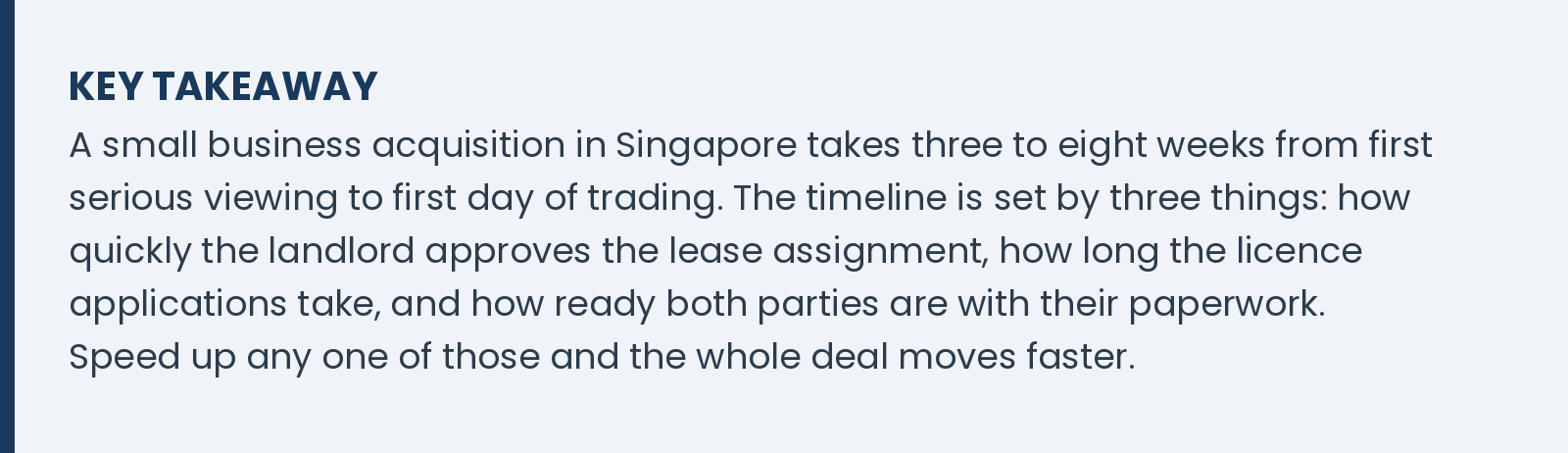
A small business acquisition in Singapore takes three to eight weeks from first serious viewing to first day of trading. The timeline is driven by three things: how quickly the landlord approves the lease assignment, how long the relevant licence takes to process, and how prepared both parties are with their paperwork. Excluding the search phase, the deal itself typically closes in two to five weeks. This guide breaks down each phase so you can plan realistically.
The deal itself is not the slow part. The paperwork around it is.
The timeline, phase by phase
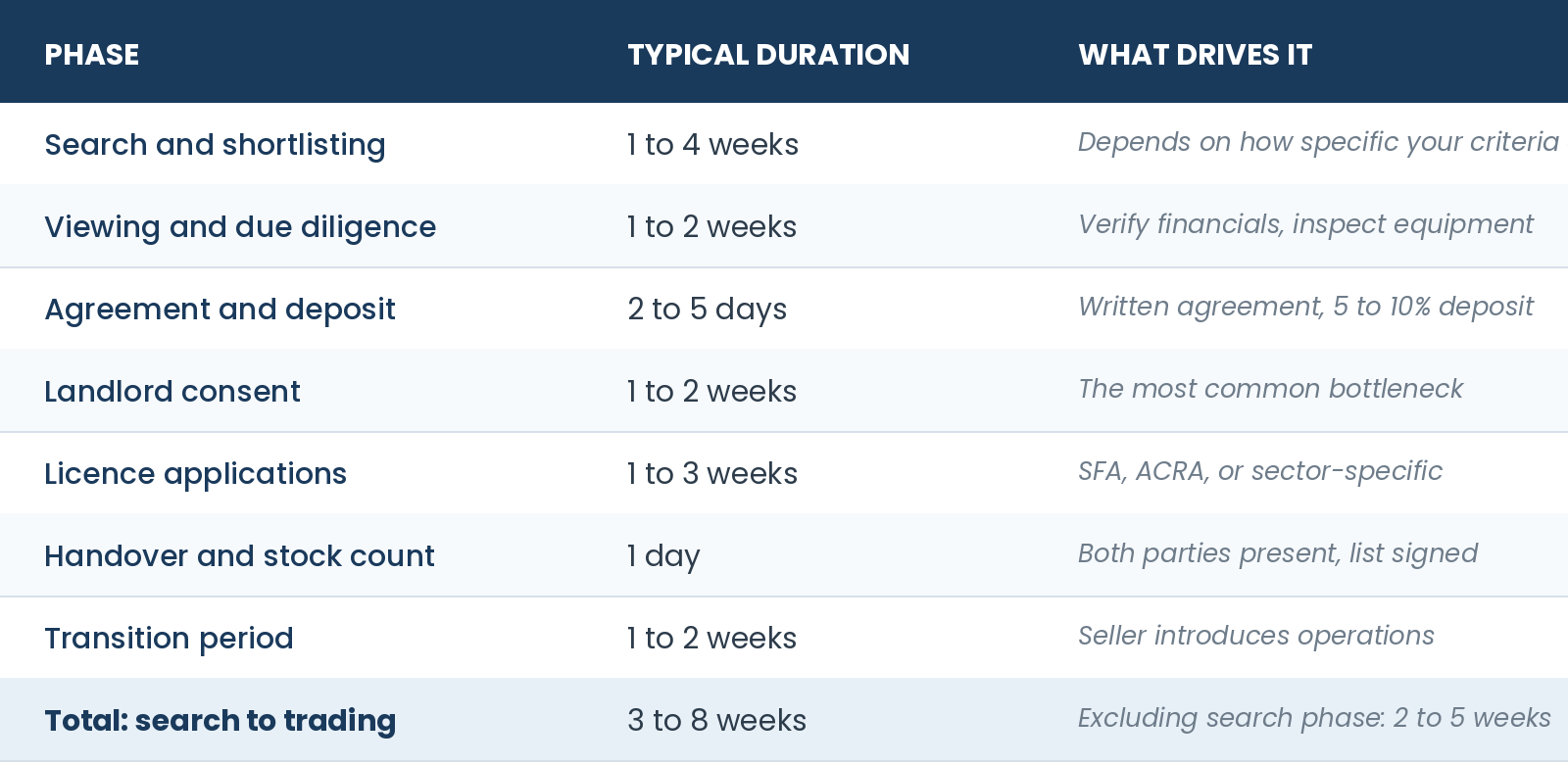
The total range depends heavily on the type of business, the landlord's responsiveness, and whether you need an SFA licence. A retail or service business with no food licence can close faster than an F&B unit where SFA processing adds a week or more.
Search and shortlisting: 1 to 4 weeks
How long you spend searching depends on how specific your criteria are. A buyer who knows they want an F&B unit in the east under S$50,000 can shortlist quickly. A buyer who is open to anything under S$100,000 across all categories may browse for weeks before narrowing down.
The search phase is entirely in your control. Use it to understand what is available at what price, rather than rushing to commit to the first listing that looks promising. Viewing three to five businesses before making an offer gives you a reference point for price, condition, and what sellers include.
Viewing and due diligence: 1 to 2 weeks
Once you have identified a listing worth pursuing, view the premises, inspect the equipment, and ask for financials. Request at least three months of POS reports, bank statements, and the tenancy agreement. Cross-check the numbers the seller quoted against the documents they provide.
A prepared seller with organised records can hand these over in a day. A seller who needs to gather documents, chase missing statements, or explain inconsistencies adds days or weeks. The speed of due diligence is usually set by the seller, not the buyer.
Agreement and deposit: 2 to 5 days
Once both sides agree on price and terms, the written agreement is drawn up and the deposit paid. A 5 to 10% deposit by bank transfer is standard. The agreement should cover what is included, the payment schedule, the handover date, landlord consent as a condition, and what happens if the deal falls through.
This phase is fast when both parties know what they want. It drags when the agreement goes through multiple rounds of revision because the terms were not discussed clearly before drafting.
For what a takeover fee typically covers and how to test whether it is fair, see our guide to business takeover fees in Singapore.
Landlord consent: 1 to 2 weeks
Landlord consent is the single most common bottleneck. Most commercial tenancies in Singapore require the landlord's or coffeeshop operator's written approval before the lease can be assigned to the incoming tenant. Some landlords respond in days. Others take two weeks or more, particularly if the property is managed by an agent or a committee.
You cannot control how fast the landlord responds, but you can prepare. Have the seller submit the assignment request as soon as the agreement is signed. Provide whatever the landlord needs, such as proof of the incoming tenant's identity, business registration, and financial standing, without delay. Every day the request sits waiting for information you could have provided is a day added to the deal.
Licence applications: 1 to 3 weeks
If the business requires an operating licence, the application timeline sits on the critical path. For F&B businesses, an SFA food shop or food stall licence typically takes seven working days for the In-Principle Approval, followed by a fit-out period and a pre-licensing inspection. The total can run two to three weeks from application to approved licence.
For non-F&B businesses, the licence requirements vary. Some retail, beauty, or service businesses have lighter regulatory requirements and can start trading sooner. Check what approvals your specific business type needs before you plan the handover date, so the licence clears before you intend to open.
Handover and transition: 1 to 2 weeks
Handover day itself takes a few hours: stock count, key collection, signed handover list, and payment of the balance. The transition period that follows, where the seller works alongside you to introduce suppliers, walk through the daily routine, and handle customer questions, typically runs one to two weeks.
Negotiate the transition period before you sign the agreement. Once the seller has been paid in full and has no remaining obligation, arranging their help becomes harder. A week of guided handover is worth more than most buyers realise until they are standing behind a counter they do not yet know how to run.
What makes deals take longer
-
Incomplete seller records. A seller who cannot produce financials, a tenancy agreement, or equipment details when asked adds weeks of back and forth to the due diligence phase.
-
Landlord delay. A slow or unresponsive landlord can stall a deal that is otherwise ready to close. There is limited recourse beyond polite follow-up.
-
Share purchases. Buying the company itself rather than just the business assets involves company searches, liability checks, and more complex documentation. Budget six to twelve weeks for a share purchase.
-
Renovation or fit-out. If the premises needs changes before you can pass the licence inspection, the renovation timeline adds to the total.
-
Financing delays. If you are applying for a bank loan or EFS facility, the approval timeline sits on top of the deal timeline. Start the financing conversation early.
When you are ready to start your search, browse businesses for sale on SG Business Mart and compare opportunities directly with owners, with no broker in between.

Frequently asked questions
How long does it take to buy a business in Singapore?
A small business takeover typically takes three to eight weeks from first serious viewing to first day of trading. The timeline is driven by landlord consent, licence processing, and how prepared both parties are. Excluding the search phase, the deal itself usually closes in two to five weeks.
What is the fastest a business takeover can close?
A straightforward takeover with a cooperative landlord, no licence delay, and both parties ready with paperwork can close in as little as two weeks. Deals this fast are uncommon but possible when the seller has a complete document pack and the premises needs no renovation.
What causes the biggest delays in buying a business?
Landlord consent is the most common bottleneck, followed by licence processing times and incomplete seller documentation. A seller who cannot produce financials, a tenancy agreement, or equipment details when asked adds weeks of back and forth.
Can I speed up the SFA licence application?
You can reduce the wait by submitting a complete application with all required documents on day one. Incomplete applications trigger Requests for Additional information from SFA, which pause the clock. Have your tenancy agreement, IRAS stamp duty certificate, and scaled layout plan ready before you apply.
Should I quit my job before the deal is done?
No. Keep your income until the licence is approved and you are legally able to trade. The gap between signing and trading is unpaid time, and extending that gap by leaving your job early adds financial pressure to a period that already has enough.
How long should I allow for the transition period?
One to two weeks of the seller working alongside you is typical. Negotiate this before you sign the agreement, because it is harder to arrange once the seller has received full payment and has no remaining obligation to help.

