Franchise vs Independent Business: Which Should You Buy?
Buying a franchise in Singapore typically costs S$10,000 to S$100,000 in franchise fees alone, plus ongoing royalties of 4 to 8% of gross revenue, while buying an independent business costs a one-time takeover fee with no ongoing percentage taken from your earnings. A franchise gives you a brand, a system, and training. An independent business gives you full control and no royalties. This guide compares both side by side so you can choose the model that fits your budget, your experience, and how much autonomy you want.
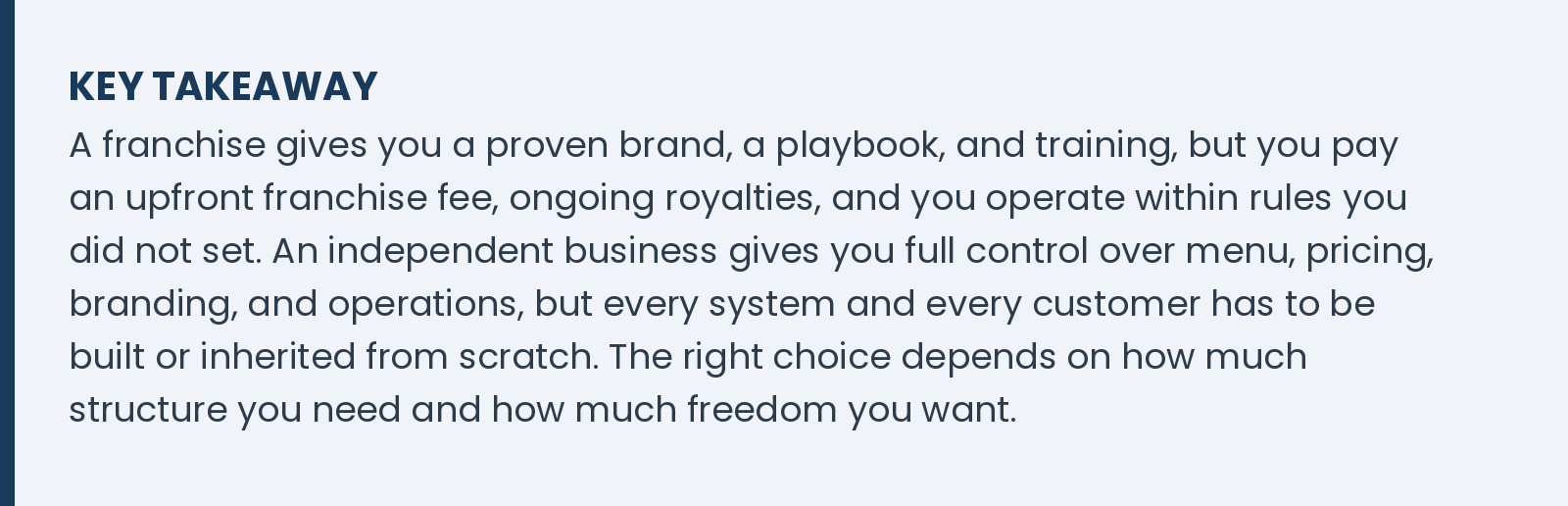
A franchise rents you a system. An independent business sells you one outright.
The cost structures are fundamentally different
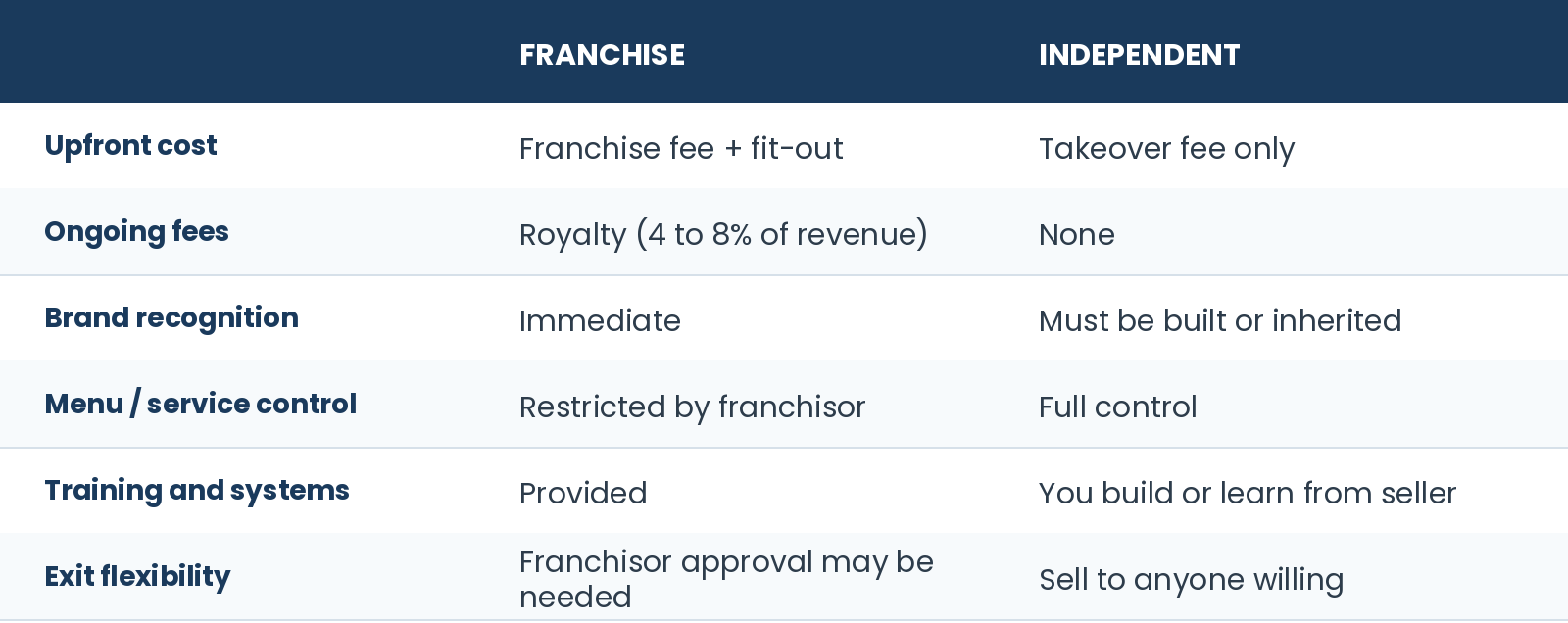
The franchise fee is just the entry ticket. Ongoing royalties, typically 4 to 8% of gross revenue paid monthly, are the real cost difference. A franchise generating S$50,000 a month in revenue pays S$2,000 to S$4,000 in royalties alone, before the marketing fund contribution, before rent, and before any other cost. An independent business at the same revenue keeps that entire amount.
The trade-off is what the royalty buys. Brand recognition means customers walk in without being told you exist. The operations manual means you do not have to invent every process. The training means your first month is not a guessing game. Whether that is worth 4 to 8% of every dollar you earn for the life of the agreement is the core question.
What a franchise gives you
A franchise provides three things an independent business does not: a known brand, a proven operating system, and structured training.
The brand matters most in competitive categories. An F&B franchise with an established name attracts foot traffic that a new independent cafe with no reputation has to earn from zero. Customers trust a name they recognise, and that trust converts to revenue from day one.
The operating system covers everything from menu design and supplier sourcing to staff training and marketing templates. A first-time business owner who has never run a kitchen or managed staff gets a playbook that would take years to develop independently.
Training is particularly valuable if you are entering an industry you do not already know. Most franchisors provide initial training before opening and ongoing support after. The quality varies by franchisor, so ask existing franchisees how useful the support actually is before you sign.
What a franchise takes away
Control is the cost of structure. A franchise agreement typically restricts your menu or service offerings, your pricing, your suppliers, your operating hours, your signage, and your renovation choices. You run the business within the franchisor's guidelines, not your own.
The royalty is perpetual. Unlike a one-time takeover fee, the royalty payment runs for the life of the franchise agreement, regardless of whether the business is profitable that month. A bad month still incurs the royalty, which can pressure cash flow when the business is underperforming.
Exit is restricted. Most franchise agreements require the franchisor's approval to sell or transfer the franchise and may include a right of first refusal. Non-compete clauses often prevent you from operating a similar business in the same area for years after exit. An independent business can be sold to any willing buyer at any time, on whatever terms you agree.
What an independent business gives you
Full control over every decision. You set the menu, the price, the brand, the operating hours, and the suppliers. You keep 100% of the revenue after costs. There is no franchisor to approve your changes, no royalty on every sale, and no brand guidelines dictating the colour of your walls.
A takeover of an existing independent business also gives you something a franchise start-up does not: a trading history. An independent cafe with three years of revenue data, a returning customer base, and trained staff is a lower-risk entry than a brand-new franchise outlet that has never served a customer at that location.
For how independent business takeover fees are structured, see our guide to business takeover fees in Singapore.
What an independent business does not give you
There is no manual. Every system, every supplier relationship, every marketing channel has to be built or inherited from the outgoing owner. If the outgoing owner ran the business on instinct rather than documented processes, you inherit a set of habits rather than a system.
There is no brand recognition beyond what the previous owner built. A neighbourhood salon that traded on the owner's personal reputation may lose clients when the face behind the counter changes. A franchise has a brand that exists independently of who runs the outlet.
There is no structured training. You learn by doing, by asking the outgoing owner during the transition period, and by making mistakes. For a first-time business owner with no industry experience, that learning curve is steeper and more expensive than the one a franchise provides.
Singapore does not have a franchise disclosure law
Unlike the United States, where franchisors must provide a Franchise Disclosure Document before selling, Singapore has no franchise-specific legislation. Franchise agreements are governed by general contract law. There is no mandatory cooling-off period and no standardised disclosure format.
This means the burden of due diligence falls entirely on the buyer. Before signing a franchise agreement, ask the franchisor for audited financial statements, a list of all existing franchisees and their contact details, the failure rate of outlets in Singapore, and the full cost breakdown including every fee, contribution, and mandatory spend. Talk to at least three existing franchisees and ask whether their actual experience matches what the franchisor promised.
Which suits you
Choose a franchise if you are entering an industry you do not know, you value a proven system over creative control, and you are comfortable paying ongoing fees for ongoing brand and operational support. The franchise model reduces the number of decisions you have to get right in the first year, which is when most new business owners are most vulnerable.
Choose an independent business if you have industry experience or are acquiring a business with an existing team, you want full control over pricing, menu, branding, and suppliers, and you prefer paying once rather than sharing revenue indefinitely. The independent model rewards operators who can build or maintain systems themselves.
When you are ready to compare options, browse businesses for sale on SG Business Mart, including both franchise and independent listings. Every listing connects you directly with the owner or franchisor.

Frequently asked questions
How much does a franchise cost in Singapore?
Franchise fees in Singapore typically range from S$10,000 to S$100,000 or more, depending on the brand. On top of the initial fee, expect ongoing royalties of 4 to 8% of gross revenue, a marketing fund contribution of 1 to 3%, and fit-out costs that the franchisor specifies. The total upfront investment is usually higher than an independent takeover at the same scale.
What are the ongoing costs of a franchise?
Most franchise agreements include a royalty fee calculated as a percentage of gross revenue, typically 4 to 8%, plus a marketing or advertising fund contribution of 1 to 3%. These are paid monthly regardless of whether the business is profitable that month. An independent business has no such ongoing fees.
Does Singapore have a franchise law?
Singapore does not have franchise-specific legislation like the US FTC Franchise Rule. There is no mandatory disclosure document. Franchise agreements are governed by general contract law. This means the buyer is responsible for their own due diligence on the franchisor's track record, financials, and existing franchisee performance.
Can I sell a franchise when I want to exit?
Most franchise agreements require the franchisor's approval before you can sell or transfer the franchise. The franchisor may also have a right of first refusal. An independent business can be sold to any willing buyer without a third party's consent, which gives you more flexibility at exit.
When is a franchise the better choice?
A franchise suits first-time business owners who want a proven system, brand recognition from day one, and structured training, and who are willing to pay ongoing fees and operate within set guidelines. If you value autonomy, want to control your own menu or pricing, or resent paying royalties on every dollar earned, an independent business is likely a better fit.
Can I convert a franchise to an independent business later?
Only if the franchise agreement allows it, which most do not. Franchise agreements typically include non-compete clauses that prevent you from operating a similar business in the same area for a period after the agreement ends. Exiting a franchise to run the same concept independently usually requires a complete rebrand, a new location, or a waiting period.

