How to Buy an E-Commerce Business in Singapore
An e-commerce business in Singapore is valued on its revenue track record, its platform seller accounts, and its supplier relationships rather than on premises or equipment. A small Shopee or Lazada store might change hands for S$5,000 to S$30,000. A DTC brand with its own website and strong monthly revenue can command S$50,000 to S$200,000 or more. The assets are entirely digital, which makes the due diligence different from any brick-and-mortar takeover. This guide covers what those digital assets are, how to verify them, and what falls apart if you miss a step.
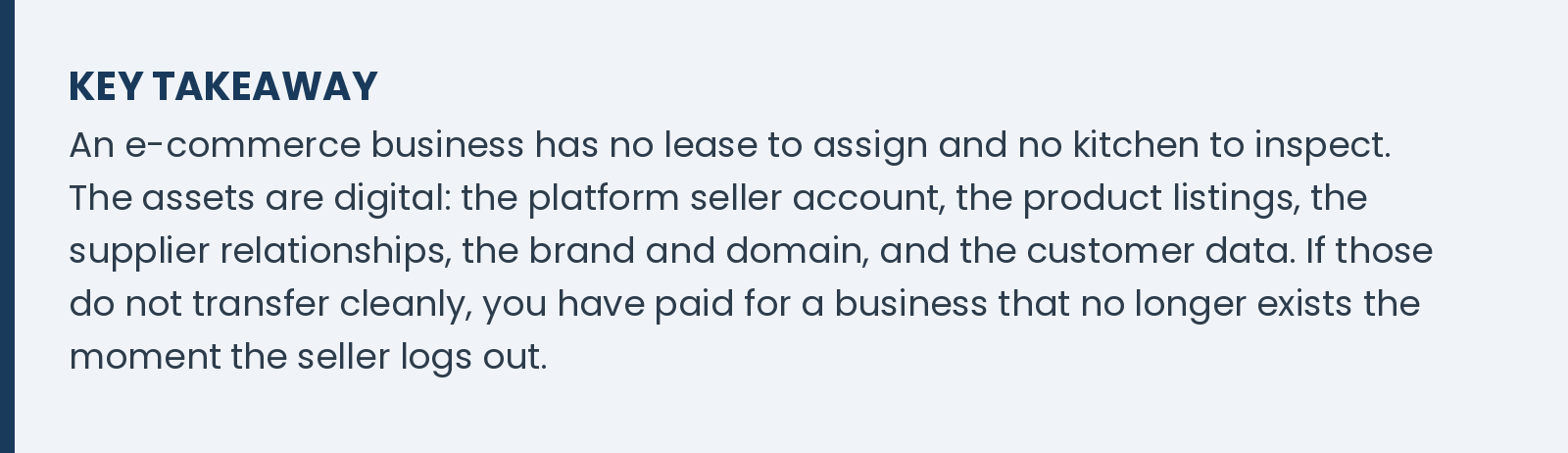
There is no kitchen to inspect and no lease to assign. The business lives inside accounts, dashboards, and supplier contacts that can vanish overnight.
What you are actually buying
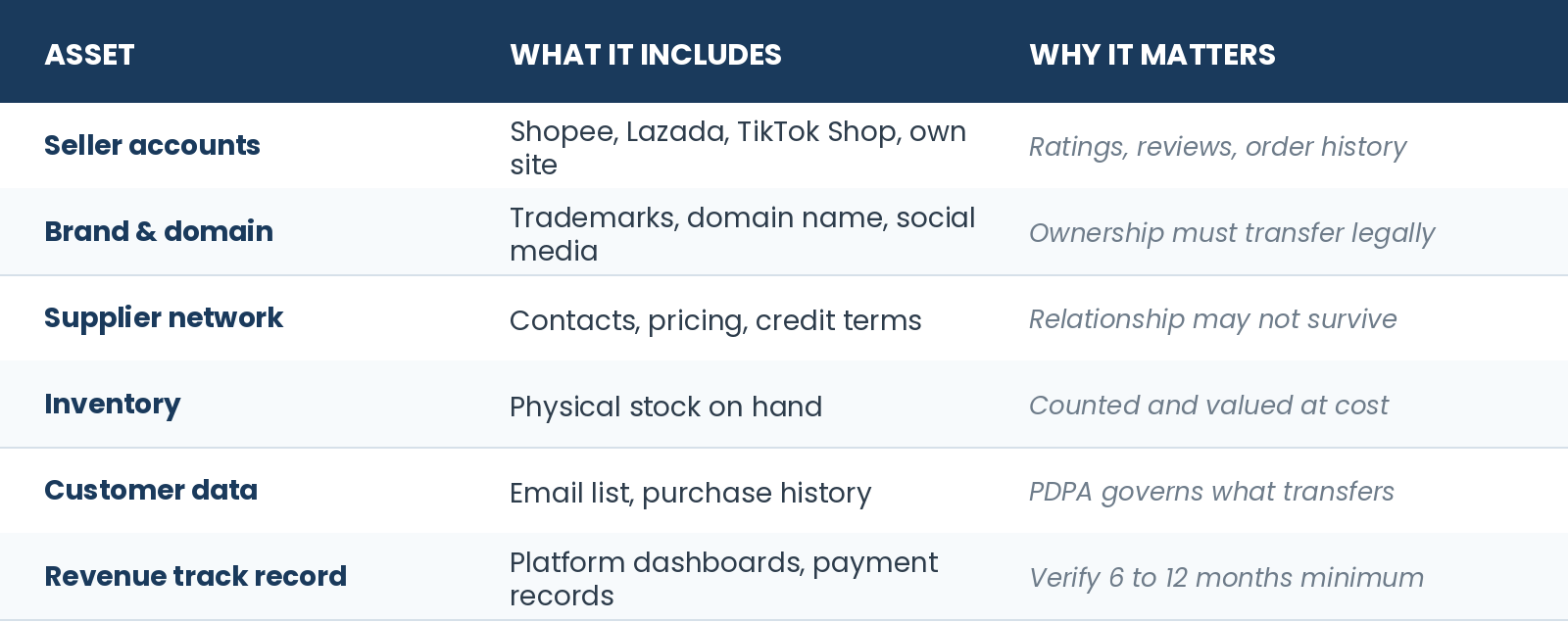
Every item in the table above needs to transfer cleanly at handover. A physical business with a lease and equipment is hard to reverse after the sale. A digital business with accounts that can be locked, passwords that can be changed, and suppliers who can stop responding is easy to lose. The transfer checklist matters more here than in any other business type.
Verifying the revenue
Revenue in an e-commerce business is easier to fake and harder to verify than in a physical one. Ask for six to twelve months of platform dashboard data showing total revenue, order count, refund rate, and return rate. Cross-check against the seller's bank statements or payment gateway records (PayNow, Stripe, PayPal).
Separate organic revenue from paid traffic revenue. A business generating S$30,000 a month but spending S$15,000 on Shopee ads, Facebook ads, or Google Shopping to drive those sales has a very different margin profile from one generating the same amount through repeat customers and organic search. The ad spend is the number most sellers leave out of their headline figure.
Check the refund and return rate. A high return rate on a fashion or electronics store eats into the revenue the dashboard shows. A 15% return rate on S$30,000 of monthly sales means S$4,500 of revenue that never actually landed.
Platform accounts and transferability
The seller account on Shopee, Lazada, TikTok Shop, or Amazon is often the most valuable single asset. It carries the product listings, the reviews, the ratings, the order history, and the algorithm ranking that took months or years to build. Losing it means starting over from zero visibility.
Platform policies on account transfers vary and change frequently. Some platforms allow the registered entity to be updated. Others require a new seller account, which means the accumulated reviews and preferred seller status do not carry across. Check the current transfer policy with each platform before you agree the deal. If the account cannot transfer, factor the cost of rebuilding from a fresh account into the price, because it will take months.
For how takeover fees work across different business types, see our guide to business takeover fees in Singapore.
Supplier relationships
A physical business depends on its lease and its location. An e-commerce business depends on its suppliers and their willingness to keep supplying at the same terms. A supplier who gave the outgoing owner exclusive pricing because of a personal relationship may not extend the same terms to you.
Ask the seller to introduce you to every key supplier before handover. Confirm that pricing, minimum order quantities, and credit terms will continue. For dropshipping businesses, this is critical: you hold no inventory, so a single supplier change can break the entire product line. Get supplier agreements in writing wherever possible, because a verbal commitment from someone you have never met is not a contract.
Brand, domain, and intellectual property
Confirm who legally owns the brand name, the domain, the social media accounts, and the product photography. A registered trademark with IPOS (Intellectual Property Office of Singapore) in the seller's personal name does not automatically transfer with the business. It needs a separate assignment.
Product photos shot by a freelance photographer may still belong to the photographer unless the intellectual property was formally assigned to the business. Custom packaging designs, logo files, and website code carry the same risk. If the seller cannot demonstrate clear ownership of the creative assets, you may not have the right to use them after the handover.
Customer data and PDPA
An e-commerce business accumulates customer personal data: names, addresses, email lists, purchase history, and sometimes payment details. Under the Personal Data Protection Act, this data was collected with consent for specific purposes. Transferring it to a new owner is not automatic.
Notify customers of the change of ownership and give them the option to withdraw consent. Do not assume the email list transfers freely just because it sits in a Mailchimp or Klaviyo account. A PDPA breach carries penalties of up to S$1 million per organisation, and the Personal Data Protection Commission has actively enforced against businesses that mishandled data during ownership transitions.
Inventory and fulfilment
If the business holds physical stock, count and value it at cost on handover day, the same way you would in a brick-and-mortar deal. Check for slow-moving or expired inventory that the seller includes in the valuation at full cost but that you will eventually write off.
Confirm how fulfilment works. A business shipping from the seller's spare room operates differently from one using a third-party logistics provider. If the fulfilment arrangement does not transfer, you need a new one in place before handover, or orders go unfulfilled from day one.
When you are ready to compare opportunities, browse e-commerce and online listings on SG Business Mart and enquire directly with sellers. No broker, no commission.

Frequently asked questions
How much does an e-commerce business in Singapore cost?
Prices vary widely. A small Shopee or Lazada store with modest monthly revenue might change hands for S$5,000 to S$30,000. A DTC brand with its own website, a trademark, and S$50,000 or more in monthly revenue can command S$50,000 to S$200,000 or higher, depending on profitability and growth trajectory.
Can I transfer a Shopee or Lazada seller account?
Platform policies on account transfers vary and change frequently. Some platforms allow the registered entity details to be updated, while others require a new account. Check the current policy with each platform before you agree the deal, because an account that cannot transfer means you lose the reviews, ratings, and order history.
What should I verify before buying an online business?
Request six to twelve months of platform dashboard data showing revenue, order volume, refund rate, and advertising spend. Cross-check against bank or payment gateway records. A business that looks profitable on revenue but spends heavily on ads to generate each sale may have thin or negative margins once ad costs are counted.
Do I need to worry about PDPA when buying customer data?
Yes. Under the Personal Data Protection Act, transferring customer personal data to a new business owner requires that the data was collected with consent for purposes that include the transfer. In practice, notify customers of the change of ownership and give them the option to withdraw consent. Do not assume the email list transfers freely.
Is dropshipping a good e-commerce business to buy?
Dropshipping businesses are the cheapest to acquire but carry the highest supplier risk. You hold no inventory, so a single supplier change can break the entire operation. Verify that the supplier relationship is documented, that the pricing is contractual rather than informal, and that the supplier has agreed to work with the incoming owner.
What intellectual property should I check?
Confirm who owns the brand name, the domain name, the product photography, and any custom packaging or design work. If the seller used a freelance designer, check whether the intellectual property was assigned to the business or remains with the designer. Unowned IP is unusable IP after the handover.

