How to Buy a Beauty Salon in Singapore
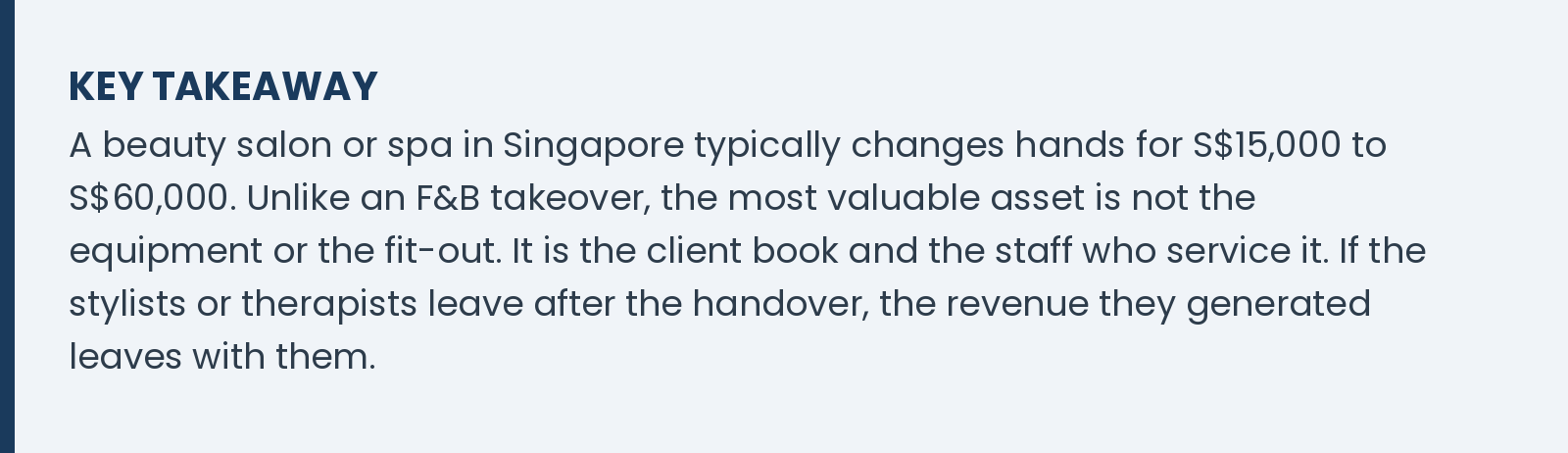
A beauty salon in Singapore typically changes hands for S$15,000 to S$60,000, with the price driven by the client book, the staff who stay, and the remaining lease rather than the chairs and basins. Unlike an F&B takeover, the most valuable asset in a salon is not the fit-out. It is the relationship between the stylists or therapists and their regular clients. If those staff leave after the handover, the revenue they generated leaves with them. This guide covers what to check, what to negotiate, and what catches first-time salon buyers off guard.
You are not buying a room full of chairs. You are buying the people who sit in them every week.
What you are actually buying
A salon takeover transfers the lease, the fit-out, the equipment, and the goodwill. But the goodwill in a salon works differently from other business types. In an F&B stall, goodwill is the location, the menu, and the foot traffic. In a salon, goodwill is the stylist's client book, and that book lives in the stylist's phone, not in the POS system.
A salon with three retained stylists and 200 regular clients who book every four to six weeks has genuine, repeatable revenue. A salon with the same chairs and the same lease but no confirmed staff retention is an empty room with nice mirrors. Price the two very differently.
The six things to check before you buy
The client book
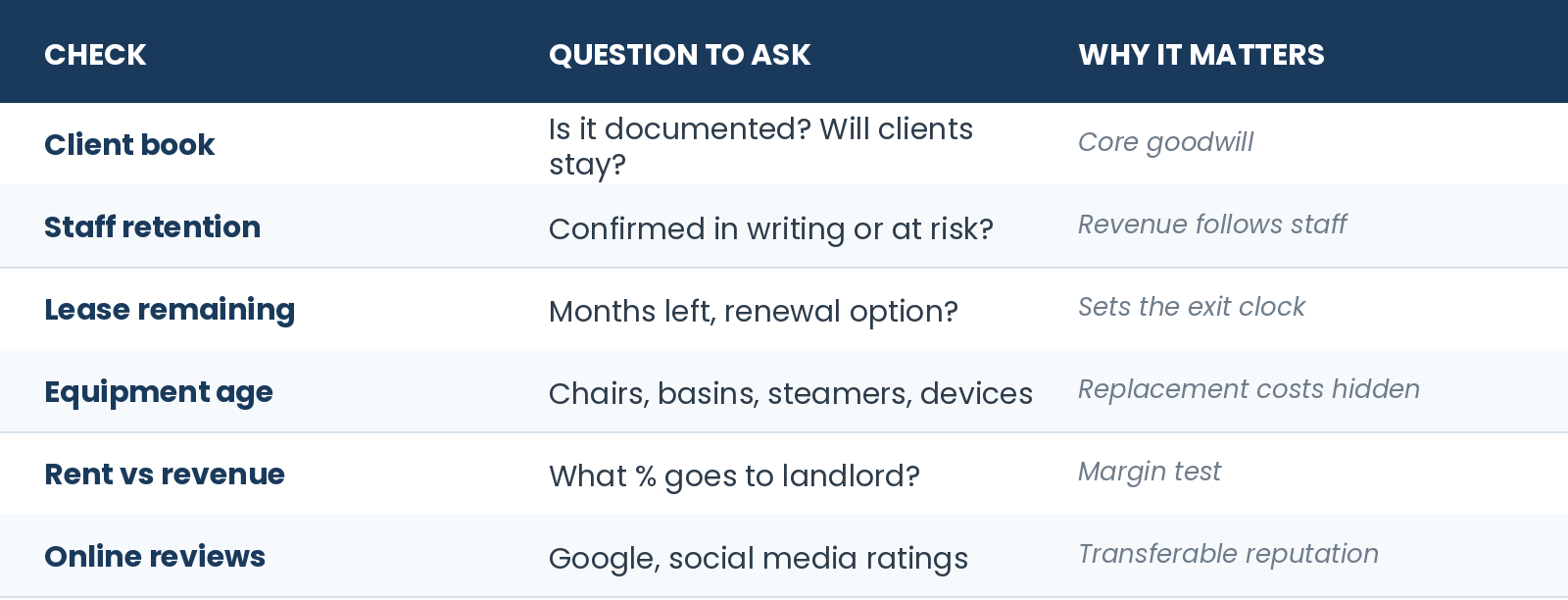
Ask how client records are kept and whether they will transfer with the business. A salon that tracks appointments, contact details, and service history in a booking system gives you something concrete to inherit. A salon where all client relationships sit in individual stylist phones gives you nothing portable.
Ask for the number of unique clients served per month, the rebooking rate, and the average transaction value. Cross-check these against POS reports or bank statements. A seller who quotes a strong client base but cannot document it is asking you to pay for something you cannot verify.
Staff retention
Meet the staff before you agree the price. Understand their terms, their commission structure, and their relationship with the owner. Ask directly whether they intend to stay. Under the Employment Act, staff contracts transfer automatically with the business, but a contract does not prevent someone from resigning.
The risk is sharpest where a salon has one or two star stylists who generate a disproportionate share of the revenue. If they leave and take their clients, the business you paid for is a fraction of what you bought. Factor staff retention into the price, not as an afterthought.
The lease
Salon fit-outs are expensive to build from scratch because of plumbing for wash basins, ventilation, electrical load for dryers and steamers, and the flooring and mirrors. That investment is locked into the premises. A short remaining lease with no renewal option means you may lose the fit-out when the lease ends, which changes the economics of the takeover fee entirely.
Equipment condition
Walk the salon and check every hydraulic chair, wash basin, steamer, hood dryer, and any specialist device. Hydraulic chairs wear out over years of daily use and cost S$800 to S$2,000 each to replace. Wash basins with plumbing issues are expensive to fix. Ask for purchase dates and confirm whether each item is owned or leased.
For how takeover fees are structured and what is included, see our guide to business takeover fees in Singapore.
Salon versus spa versus aesthetic clinic
These three fall under the same platform category but have different risk profiles.
A basic beauty salon, whether hair, nails, lashes, or brows, operates with relatively light regulation. You need ACRA business registration and compliance with workplace safety and health requirements, but there is no sector-specific operating licence comparable to the SFA food shop licence.
A spa offering massage, body treatments, or facials operates similarly, though premises with shower facilities may need additional building compliance depending on the setup.
An aesthetic clinic offering treatments such as laser, injectables, or medical-grade devices sits in a different regulatory space entirely. These require medical practitioner oversight, compliance with the Private Hospitals and Medical Clinics Act, and device-specific approvals. Buying an aesthetic clinic is materially more complex than buying a hair salon, and the price reflects it.
What salon buyers consistently underestimate
Consumable costs eat into margin faster than most buyers expect. Hair colour, treatment products, waxing supplies, and disposables are ongoing costs that scale with client volume. Ask the outgoing owner for monthly consumable spend and check it against the gross revenue, because a salon with impressive top-line numbers and thin margins after consumables is less profitable than it looks.
Online reputation is harder to rebuild than most buyers assume. A salon with 200 Google reviews and a 4.7 rating has years of compounded trust. Changing the name, the branding, or the key staff resets that to zero. Keep the name and the public profiles through the transition unless there is a strong strategic reason to rebrand.
When you are ready to compare opportunities, browse beauty and salon listings on SG Business Mart and enquire directly with owners. No broker, no commission.

Frequently asked questions
How much does it cost to buy a beauty salon in Singapore?
Most beauty salon takeovers in Singapore fall between S$15,000 and S$60,000, depending on the size of the unit, the equipment, the remaining lease, and the strength of the client book. A salon with proven, documented repeat clients and retained staff commands the top of the range.
What is the most important thing to check before buying a salon?
Staff retention. In a salon business, clients follow the stylist or therapist, not the brand. If the key staff leave after the takeover, the revenue they generated goes with them. Confirm which staff are staying and get it in writing before you agree the price.
Do I need a licence to run a beauty salon in Singapore?
A basic beauty salon such as a hair salon, nail salon, or lash studio does not require a specific operating licence from a regulatory agency in the way an F&B business needs an SFA licence. You do need a standard business registration with ACRA and compliance with workplace safety and health requirements. Aesthetic clinics offering medical aesthetic treatments are subject to separate regulations and require medical practitioner oversight.
What equipment should I inspect before buying a salon?
Check every hydraulic chair, wash basin, steamer, dryer hood, and any specialist device such as a facial machine or laser unit. Note the brand, age, and servicing history. Confirm whether each item is owned outright or on a lease, because leased equipment does not transfer with the sale.
Can I change the salon's name after buying it?
Yes, but consider the cost. An established name with Google reviews, social media followers, and returning clients carries real value. A name change resets that presence to zero, which means rebuilding trust and visibility from scratch. Keep the name at least through the transition unless there is a strong reason to change it.
Is location or client book more important for a salon?
Client book. A well-located salon with no regular clients depends on walk-in traffic that any competitor can capture. A salon with a strong client book and retained staff in a quieter location can generate steady, repeatable revenue because those clients book by appointment rather than walking past.

