How to Finance a Business Acquisition in Singapore
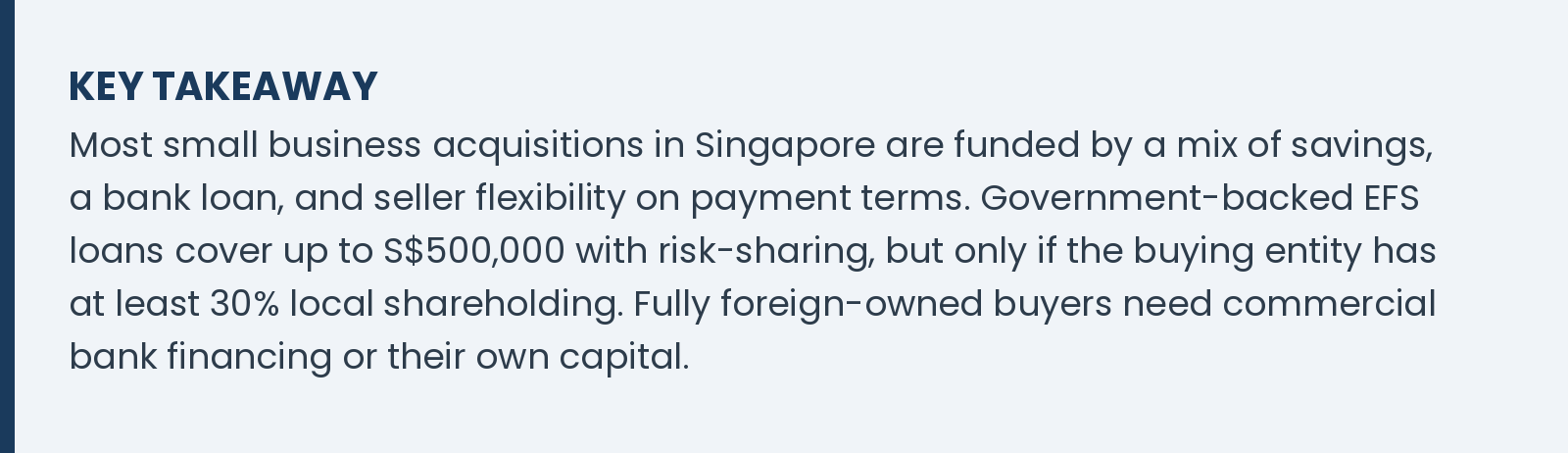
Most small business acquisitions in Singapore are funded by a mix of personal savings, a bank loan, and seller flexibility on payment terms. Government-backed EFS loans cover up to S$500,000 with risk-sharing for qualifying buyers, while commercial bank term loans are available to companies with a trading history. This guide covers the five realistic funding options, who qualifies for each, and how to structure a deal you can afford.
The question is not whether you can borrow. The question is whether the business earns enough to cover the repayment.
The five ways to fund a business purchase in Singapore
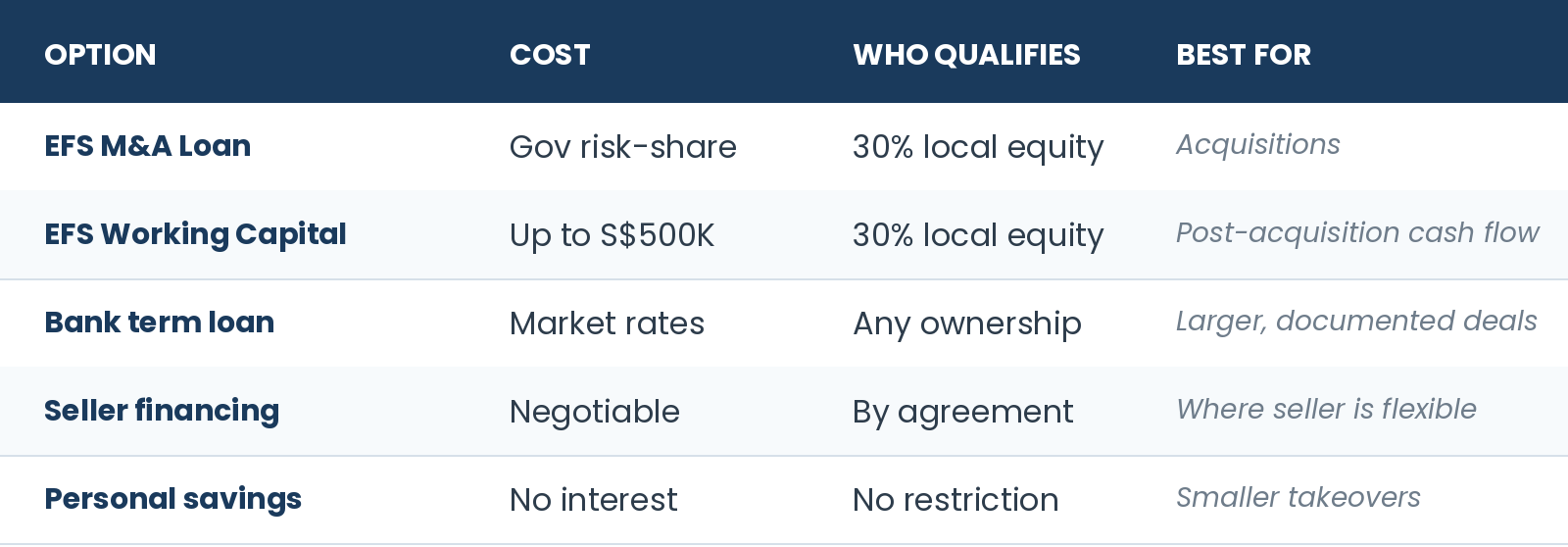
Each option suits a different deal size and buyer profile. Most completed acquisitions use two or three of them together.
Government-backed EFS loans
The Enterprise Financing Scheme, administered by EnterpriseSG, includes a specific M&A Loan for companies pursuing acquisitions. It also includes a Working Capital Loan of up to S$500,000 that can cover post-acquisition cash flow. Both products carry government risk-sharing, which means the participating bank shares the default risk with EnterpriseSG and can offer terms it otherwise would not.
Eligibility is the catch. The buying entity must be Singapore-registered, have at least 30% local shareholding, report annual group revenue below S$500 million, and employ fewer than 200 staff. You apply through a participating financial institution such as DBS, OCBC or UOB, not through EnterpriseSG directly. Budget 2026 enhanced several EFS products effective April 2026, so confirm the current terms with the lender.
For buyers who qualify, the EFS M&A Loan is the most acquisition-specific financing product available in Singapore. For fully foreign-owned buyers, it is off the table, and commercial options apply instead.
Commercial bank term loans
DBS, OCBC and UOB all offer business term loans that can fund an acquisition. The bank assesses the buying entity's financials, not the target business, so a newly incorporated company with no revenue history faces a harder approval than an existing business adding a second outlet.
Expect the bank to ask for at least two years of financial statements, recent bank transaction history, and personal guarantees from the directors. Collateral is not always required for smaller facilities, but it strengthens the application. Interest rates sit at commercial levels, typically starting from around 5 to 8% per annum depending on the risk profile, and repayment periods run from one to five years.
For larger deals involving a share purchase of an established company, the bank may be willing to lend against the target's assets or cash flow. For a small hawker or cafe takeover at S$30,000, a personal loan or a smaller business overdraft is often simpler.
Seller financing
Seller financing means the seller agrees to receive part of the purchase price over time after handover, rather than demanding the full amount upfront. A common structure is 50 to 70% paid at handover, with the balance over three to twelve months. No bank is involved, and the terms are whatever buyer and seller agree.
Sellers accept this when they believe the business will keep earning, because the deferred payments give them ongoing income and the buyer ongoing incentive to keep the business healthy. It also widens the pool of buyers who can afford the deal, which helps the seller move a listing that might otherwise sit.
For how takeover fees are typically structured and what is included, see our guide on business takeover fees in Singapore.
Personal savings and family capital
For smaller takeovers, particularly hawker stalls, coffeeshop units and beauty salons priced under S$50,000, personal savings are the most common funding source. There is no application process, no interest, and no repayment schedule competing with the business for cash flow.
The risk is straightforward: if the business does not work out, the money is gone. Budget enough to cover the takeover fee, the deposit, stock, and at least two to three months of working capital. Walking into a new business cash-strapped, with rent due in four weeks and no buffer, is how owners end up underfunding the very thing they just bought.
What a lender will ask you
Whether you apply through an EFS product or a commercial bank loan, the documents are similar. Expect to provide two years of financial statements for the buying entity, six months of bank transaction history, a business plan or acquisition rationale, the signed or draft takeover agreement, and personal guarantees from the directors. For EFS products, the lender also checks your company structure against the 30% local shareholding rule.
Approval speed varies. A small unsecured facility can clear in a week. A larger EFS-backed loan with collateral takes longer. Start the conversation with the bank early, ideally before you sign the takeover agreement, so the financing timeline does not hold up the deal.
Which option fits which deal
A hawker stall at S$15,000 rarely needs a bank loan. Personal savings plus a short seller-financing arrangement covers it, and the deal can close in days. A salon at S$50,000 might combine savings with a small business loan. A restaurant at S$150,000 with an established team and verified revenue is where the EFS M&A Loan or a bank term loan earns its place, because the deal is large enough to justify the paperwork and the business has numbers to back the application.
Match the financing to the deal, not the other way around. Borrowing S$200,000 to buy a business that nets S$3,000 a month creates a repayment burden the business cannot carry. Run the numbers before you commit: monthly loan repayment plus rent plus payroll plus your own living costs, against realistic monthly revenue, with a margin for slow months.
When you are ready to look at what is available, browse businesses for sale on SG Business Mart and compare asking prices against what you can realistically fund. Every listing connects you directly with the owner, with no broker commission.

Frequently asked questions
Can I get a government loan to buy a business in Singapore?
Yes. The Enterprise Financing Scheme includes an M&A Loan specifically for business acquisitions. The buying entity must be Singapore-registered with at least 30% local shareholding, annual group revenue below S$500 million, and fewer than 200 employees. Apply through a participating financial institution, not through EnterpriseSG directly.
How much deposit do I need to buy a business in Singapore?
A good-faith deposit of 5 to 10% of the takeover fee is standard. Budget for the full takeover fee, a security deposit of one to three months of rent, stock at handover, and at least two to three months of working capital. Most small acquisitions require 30 to 50% of the total cost as upfront cash even when a loan covers part of it.
Do banks lend money for business takeovers?
Yes. DBS, OCBC and UOB all offer business term loans that can fund an acquisition, though they assess the buying entity's financials, not the target business. For smaller takeovers under S$100,000, personal savings or a combination of savings and a smaller business loan is more common than a dedicated acquisition facility.
What is seller financing in a business acquisition?
Seller financing means the seller agrees to receive part of the purchase price over time after handover, rather than demanding the full amount upfront. It works when the seller has confidence the business will continue to earn, and it lowers the buyer's upfront cash requirement. Terms are negotiated directly between buyer and seller.
Can a foreigner get a business loan in Singapore?
Foreigners face a narrower set of options. EFS loans require at least 30% local shareholding, which most fully foreign-owned entities do not have. Commercial bank loans are available but typically require the company to be Singapore-registered with a trading history, which a newly incorporated entity does not have. Most foreign buyers fund the acquisition from personal capital or overseas financing.
Should I pay cash or borrow to buy a business?
It depends on the size of the deal and your cash reserves. Paying cash avoids interest and speeds the deal, but it can leave you short on working capital for the critical first months. Borrowing preserves liquidity but adds a monthly repayment that the business needs to cover from day one. The strongest position is usually a mix: enough cash to close, with a facility in reserve for working capital.

