How to Buy a Business in Singapore as a Foreigner
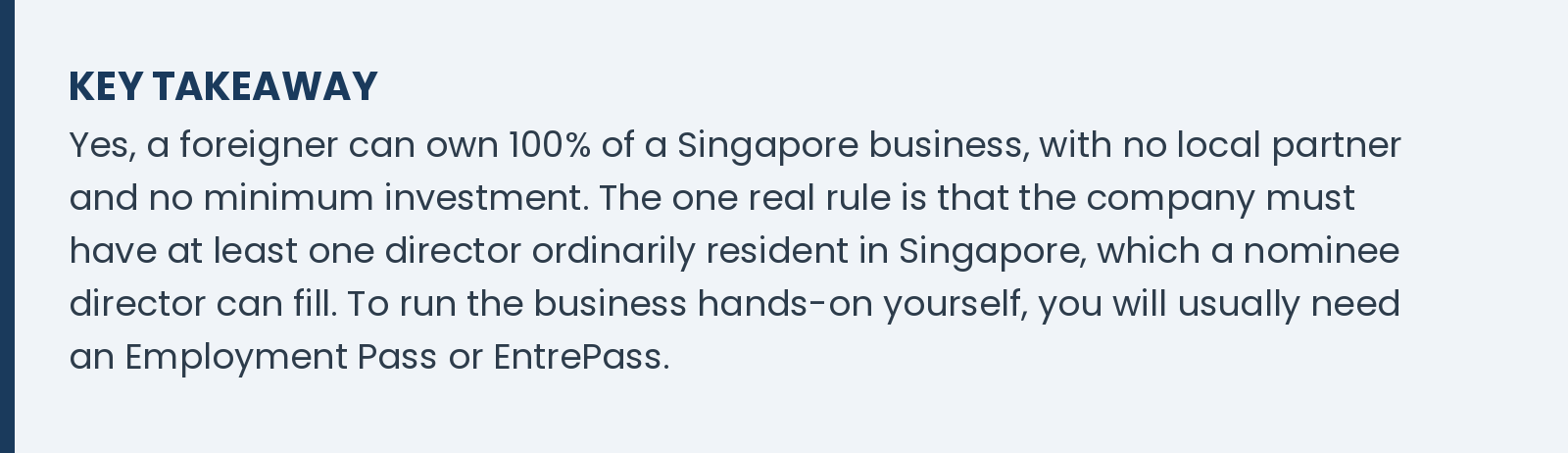
Yes, a foreigner can buy and own 100% of a business in Singapore, with no local partner and no minimum investment. The one structural rule is that the company must have at least one director who is ordinarily resident in Singapore, a role a nominee director can fill. This guide covers the two ways to buy, the rules that apply, and what to check before you commit.
Owning a Singapore business from abroad is straightforward. Running one hands-on is what triggers the work-pass question.
The two ways a foreigner buys in
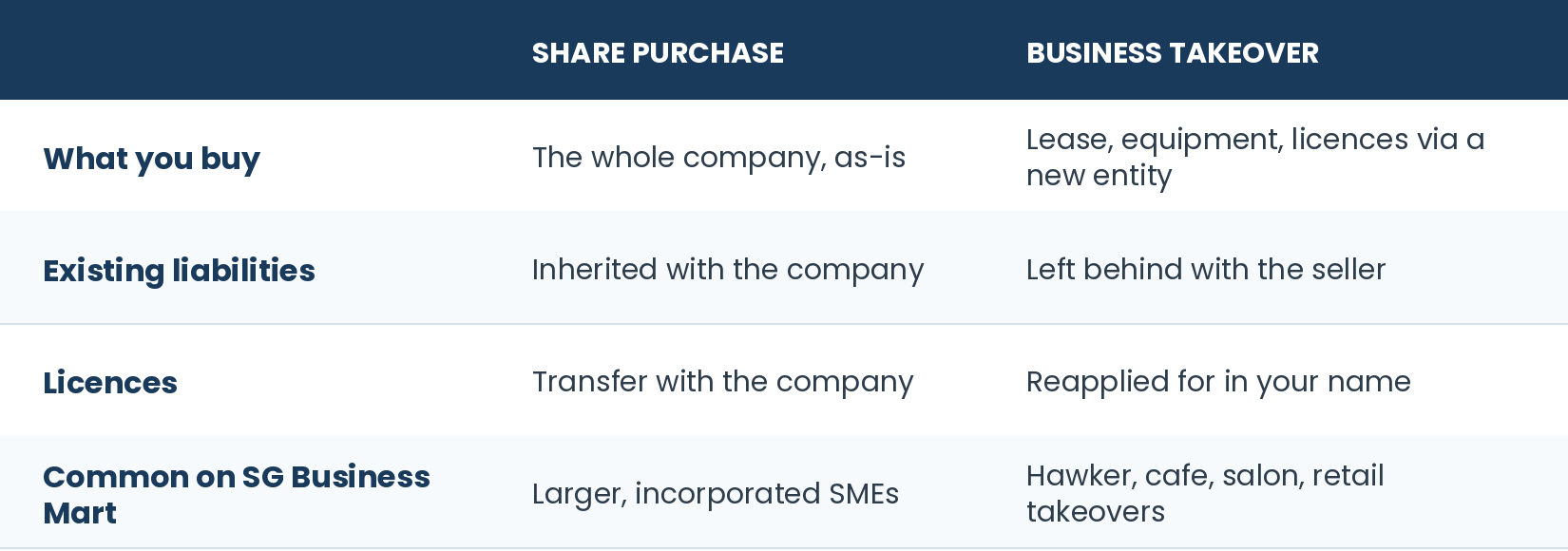
Every acquisition takes one of two shapes, and the difference decides what you inherit.
A share purchase means buying the existing company itself. You step into the same legal entity, keep its contracts and licences, and also take on its liabilities, its tax history, and anything hidden in its books. This suits larger, properly incorporated SMEs where the company name and its track record carry value.
A business takeover means setting up your own Singapore company and buying only the lease, equipment, and goodwill. The seller's past liabilities stay behind. Most smaller listings on the platform, from hawker and coffeeshop stalls to cafes, salons, and retail units, change hands this way, because the buyer wants the operation without the seller's history.
For how Singapore buyers assess a smaller business before an offer, see our guide to selling an SME in Singapore from the buyer's side of the same checks.
The one real requirement: a resident director
Foreign ownership itself is unrestricted for most sectors. Full ownership covers shares, profit rights, and control, and profits can be sent home without foreign-exchange restrictions. What Singapore does require is local management presence.
Under the Companies Act, every Singapore company must have at least one director who is ordinarily resident in Singapore. That means a citizen, a permanent resident, or a holder of an Employment Pass, EntrePass, or Dependant's Pass with a Letter of Consent. A foreign owner who does not hold any of these cannot be the sole director on paper.
The standard fix is a nominee director, a resident who sits on the register to satisfy the rule while you keep full ownership and control. Note that ACRA tightened its transparency rules around nominee arrangements in 2026, so use a licensed provider and keep the arrangement properly documented.
Do you need to move to Singapore?
Owning and operating part ways here, and it is the question most first-time foreign buyers get wrong.
To own a business and let a local team or manager run it, you do not need to relocate. A nominee director covers the statutory requirement, and you can hold the shares from anywhere. Many foreign owners incorporate remotely without setting foot in Singapore.
To run the business yourself day to day, standing behind the counter of the cafe you bought, you need the right to work here. That means an Employment Pass, or an EntrePass for an innovative or higher-growth venture. Buying a hawker stall and planning to cook in it without a work pass does not work, however willing the seller is.
How the incorporation and transfer actually happen
Foreigners cannot self-register on ACRA's BizFile portal, so the practical route runs through a licensed local filing agent, usually a corporate services firm.
-
Appoint a resident director, or engage a nominee director if you are staying abroad.
-
Provide a local registered address and appoint a company secretary within the required timeframe.
-
Have the filing agent incorporate the new Pte Ltd through BizFile, which for a standard application clears quickly.
-
Sign the takeover or share-purchase agreement and complete the lease assignment with the landlord's written consent.
-
Reapply for any operating licences in the new entity's name, such as an SFA food shop licence for an F&B unit.
Budget for recurring local costs alongside the purchase price: a company secretary, a registered address, and, if you use one, a nominee director, which typically runs a few thousand dollars a year. These are market rates that vary by provider, not platform fees.
Extra due diligence for foreign buyers
Everything a local buyer checks still applies, and buying from a distance adds a few of its own.
Confirm the landlord will assign the lease to your new entity before you pay anything. A takeover collapses if the tenancy cannot move to you. Check which licences transfer and which must be reapplied for, since a gap in licensing can stop trading on day one.
Verify the numbers rather than trusting a summary. Ask for bank statements, POS reports, and IRAS filings, and reconcile them against the asking price. When you cannot inspect in person, appoint someone you trust to view the premises and equipment on your behalf.
Check the sector. Most industries are open to full foreign ownership, but a few are regulated or need approvals, and the 2026 Companies Act changes raised the compliance bar on some transactions. A short conversation with a licensed corporate services firm or a lawyer before you sign is cheaper than unwinding a deal after.
When you are ready to see what is available, you can browse businesses for sale on SG Business Mart and enquire directly with owners, with no broker in between. Filter by category and district to match what you can realistically run or oversee.

Which businesses actually suit a foreign buyer
The best match depends on how involved you can be, not just on the asking price. A business that runs on trained staff and documented systems can be owned from overseas and overseen through a local manager. A business that works only because the current owner is behind the counter every day needs you on the ground, which brings the work-pass question back into play.
If you plan to stay abroad, favour listings with a stable team, recurring revenue, and operations that do not depend on one person. If you are relocating and intend to run the business yourself, an owner-operated cafe or stall can work well, provided you secure the right pass first. Match the listing to your real availability before you fall for the numbers, because a good business you cannot properly oversee rarely stays a good business for long.
Frequently asked questions
Can a foreigner buy a business in Singapore?
Yes. A foreigner can buy and own 100% of a Singapore private limited company, with no local partner and no minimum investment beyond the S$1 paid-up capital. Foreign ownership is unrestricted in most sectors.
Do I need to live in Singapore to own a business here?
No. You can own a Singapore company while living overseas by appointing a nominee director to satisfy the resident-director rule. You only need to relocate if you want to run the business hands-on yourself, which requires an Employment Pass or EntrePass.
What is the resident director rule?
Every Singapore company must have at least one director who is ordinarily resident in Singapore, meaning a citizen, permanent resident, or holder of an Employment Pass, EntrePass or Dependant's Pass with a Letter of Consent. A foreign owner who does not qualify can appoint a nominee director.
Can foreigners register a company on ACRA directly?
No. Foreigners cannot self-register on ACRA's BizFile portal and must appoint a licensed local filing agent to submit the incorporation. You also need a local registered address and a company secretary.
Is it better to buy the company or just take over the business?
A share purchase transfers the whole company including its liabilities, while a business takeover moves only the lease, equipment and licences into a new entity you control. Most smaller listings such as hawker stalls, cafes and salons change hands as takeovers, which leaves the seller's past liabilities behind.
What should a foreign buyer check before buying a business in Singapore?
Confirm the landlord will assign the lease to your new entity, check which licences must be reapplied for, verify the financials with bank statements and IRAS filings, and confirm whether the sector has any foreign-ownership or approval conditions. Engage a licensed corporate services firm or lawyer for the incorporation and transfer.

